Training
The Army ROTC program wants to give its cadets the best experiences available to help for them as future leaders in the Army. Cadets learn from Field Training exercises and leadership laps, as well as special training like Airborne and Air Assault School. Cadets learn many valuable skills from these training events and will use them on a daily basis while serving in the Army.
Field Training Exercises
(Top)
FTXs give cadets the opportunity to have hands on training related to the Army. The cadets will learn rifle marksmanship, grenade basics, and team leadership through specially designed obstacle courses. They will also experience squad based missions in a natural environment and learn to navigate the land using a map and compass. FTXs are used to build the cadets knowledge and prepare them for future training at places such as LDAC.
Leadership Labs (Top)
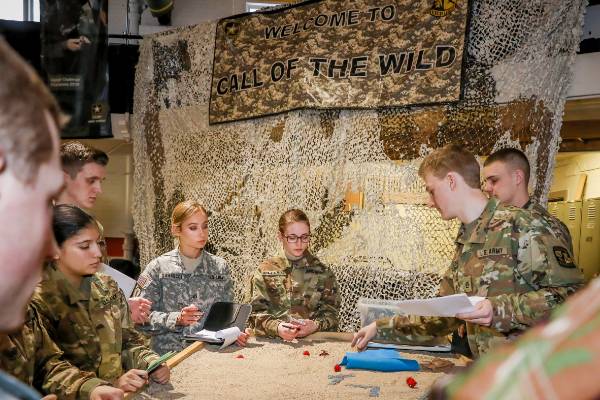
Leadership labs are held once a month throughout the semester and are used to help build and retain the cadets’ knowledge of Army tasks and skills. The cadets use lab to perfect skills like preparing and briefing missions, as well as executing these missions. Cadets are also evaluated by the senior leadership so they can learn from the mistakes they make and better themselves for the next lab. Lab ultimately prepares every cadet for the FTXs and LDAC.
Leadership Development and Assessment Course (Top)
Every Army ROTC Cadet who enters into the Advanced Course attends the Leader Development and Assessment Course. It's a five-week summer course to evaluate and train all Army ROTC Cadets. This course normally takes place between your junior and senior years of college, and is conducted at Fort Lewis, Washington.
Leader's Training Course (Top)
LTC is four weeks of intense classroom and field training held in the summer at Fort Knox, KY. This course is an accelerated version of the two years of leadership development training Cadets receive in the Basic Course. By transforming yourself through this rigorous training, you will qualify for enrollment in the Army ROTC Advanced Course on campus-provided you have two years of college remaining (undergraduate or graduate). Once you successfully complete LTC and agree to contract and enter the Advanced Course, you may also qualify to receive a $5,000 bonus.
Cadet Troop Leader Training (Top)
The Cadet Troop Leader Training track provides Cadets the opportunity to experience leadership in Army Table of Organization and equipment (TO&E) units over a three to four week period. Cadets serve in LT level leadership positions in active duty units. Platoon Leader positions have a 3-4 week duration depending on the hosting unit and location. Assignments include units that are located CONUS and OCONUS. Cadets are assigned a unit mentor, and are provided on-post lodging and meals via a Dining Facility. This program is exclusively designed for MSIII Cadets. This program is exclusively designed for MSIII Cadets before and after completion of LDAC.
Drill Cadet Leadership Training (Top)
The 4-week DCLT program provides Cadets serve in a platoon leader or executive officer positions in IMT companies and work closely with Drill Sergeants and other cadre. Cadets experience leadership training with Initial Military Training (IMT) Companies. Positions lengths vary in duration depending on the host unit and location. Cadets an opportunity to apply leadership skills, interact with highly skilled and experienced Noncommissioned Officers (NCOs) and drill sergeants, and improves common task skill proficiency in an Army training environment. Cadets must attend a Staff Cadre Training Course (SCTC) prior to training in IMT units .This program is exclusively designed for MSIII Cadets.
Culture Language Program (CULP) (Top)
The Department of the Army is currently developing a comprehensive strategy to define, assess, and train culture and language proficiency skills. Part of this strategy is expected to address how Cadet Command increases Cadet language learning exposure. Cultural awareness training is already incorporated into our curriculum, at LDAC, and now via many more overseas culture immersion internship opportunities. Increase number of Cadet cultural immersion opportunities using existing programs to minimize additional resource requirements. Participating Cadets develop culture awareness skills and appreciation of cultural differences and recognize potential impact on assigned missions.
Airborne (Top)
Army Airborne School is where cadets are trained to become paratroopers. The 3 week course consists of a ground phase, a tower phase, and jump week. Cadets will learn to properly jump from the aircraft will full military equipment and land on the ground successfully. Cadets will make 5 jumps from an aircraft and upon completion, will be awarded the Airborne badge, which they can wear on their uniform for the rest of their Army career.
Air Assault (Top)
Like Airborne School, Air Assault is a specialized form of training cadets can take part in. At Air Assault, cadets learn to rappel, fast rope, and sling load equipment to helicopters. The course is 12 days long and is completed with a timed 12 mile ruck march. Upon successful completion of all required tasks, cadets will be awarded the Air Assault badge, which like the Airborne badge, can be worn on their uniform for their entire Army career.