National Security
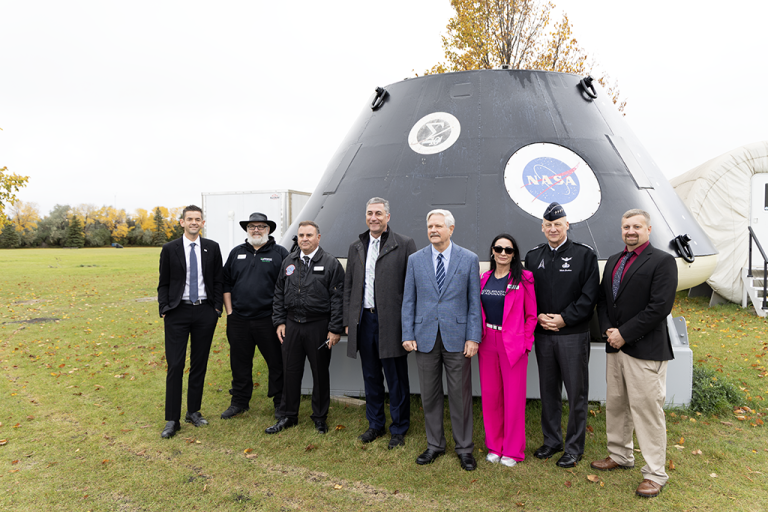
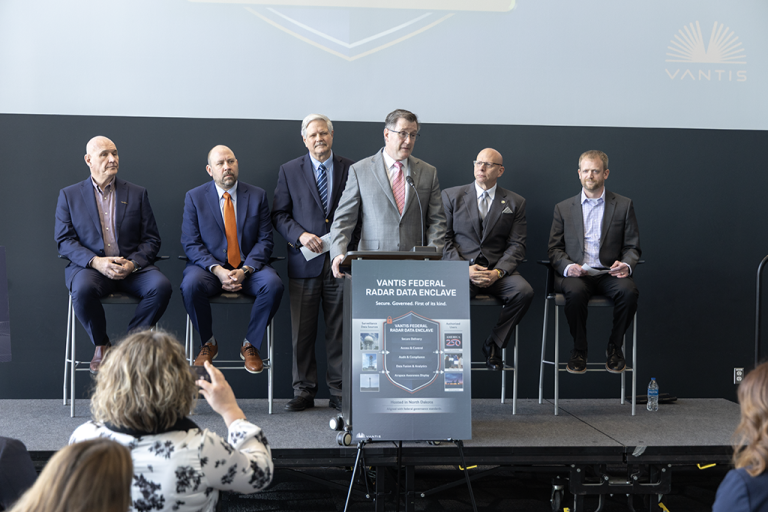
There’s a reason the leaders from NASA, the U.S. Space Force and the U.S. Space Command paid visits to UND.
They see the University’s potential to conduct valuable research for the technologies they need and to educate the nation’s space workforce of the future.
National Security Initiative
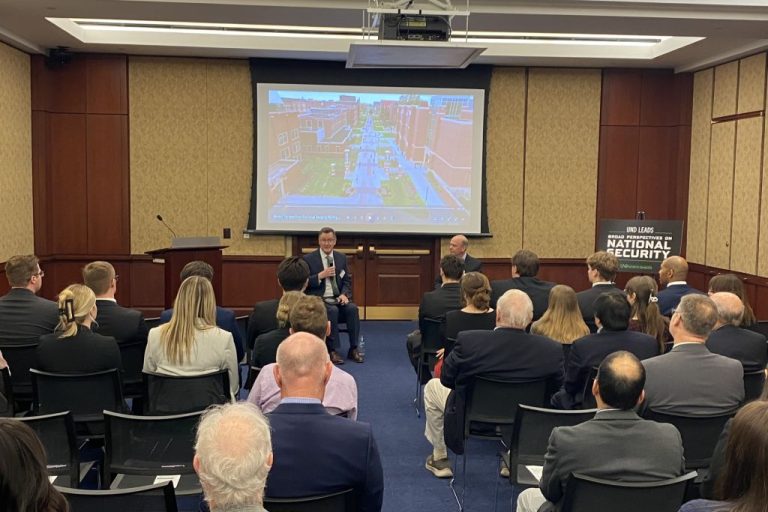
The University of North Dakota is advancing the nation's defense and space capabilities through cutting-edge research, workforce development and strategic partnerships. The National Security Initiative (NSI) builds capacity in autonomy, space operations, medicine and energy - supported by millions in new UND investments and state funding for space-related research infrastructure to pursue, secure and execute projects with federal agencies not yet fully accessed by the university. This includes the Department of Defense (DOD) and Department of Homeland Security (DHS).
The NSI generates extensive opportunities in research, training and education for a broad range of colleges, schools, programs, faculty, undergraduate and graduate students across broad areas of:
- Autonomy
- Space
- Medicine
- Deployed Health
- Energy
Demonstrated UAS Expertise
The first phase of the NSI is extending UND’s demonstrated expertise in UAS/Autonomy and mobility in Surface-Maritime-Air-Space (SMAS) domains, from ground vehicles to the satellite architecture under development by the Space Development Agency (SDA) and private industry.
UND has a 6-year plan, in which it has committed to investing $9M in new strategic funding in this initiative. FY22-FY27 will be in a “Phase I” focused on Space and Autonomy and building on the $23M the State of North Dakota has invested to fund space-related education and research infrastructure at UND.
Leaders in Space Research
UND became the first of ten universities to join the new Space Force University Partnership Program (UPP), signed on August 9, 2021.
- NSI will further support our partnerships with the SDA and Grand Forks Air Force Base as well as numerous potential industry partners.
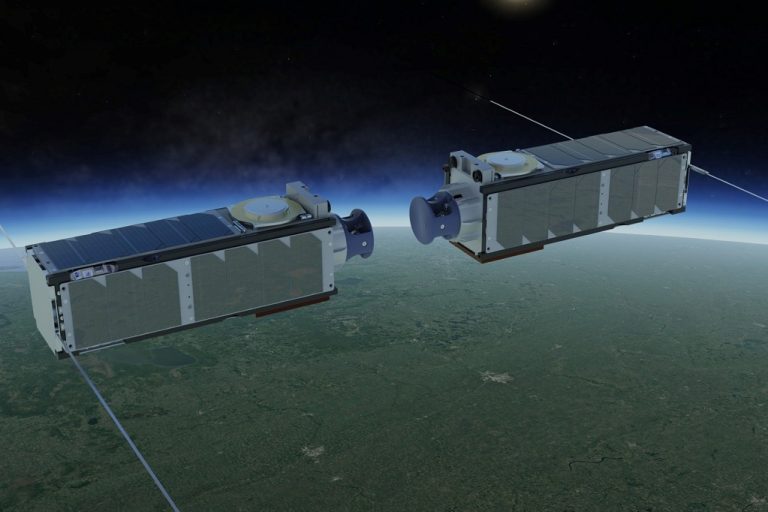
- As Space Command makes plans to develop a network of low-earth orbit satellites for national defense, UND’s expertise in command and control of autonomous systems and its solid partnership with the Northern Plains UAS Test Site makes it an attractive partner for potential collaborations.
- As the DOD more broadly has set strategy to modernize, develop and optimize autonomous systems across the services, it is critical to integrate autonomous systems capabilities across surface, maritime, air and space (SMAS) domains.
- UND is positioned to address current technological limitations including survivability, mission command systems, the data problem (networks, computing power, edge computing), AI (including trust and decision-making) and energy.
- The DOD is expanding resources through partnerships with industries and academia. These enable development of U.S. produced systems and the workforce needed to build, innovate, and transform them.
UND's Capabilities
The NSI builds on previous work to position UND as a leader in relevant research and education, including the following entities/units:
- Research Institute for Autonomous Systems (RIAS)
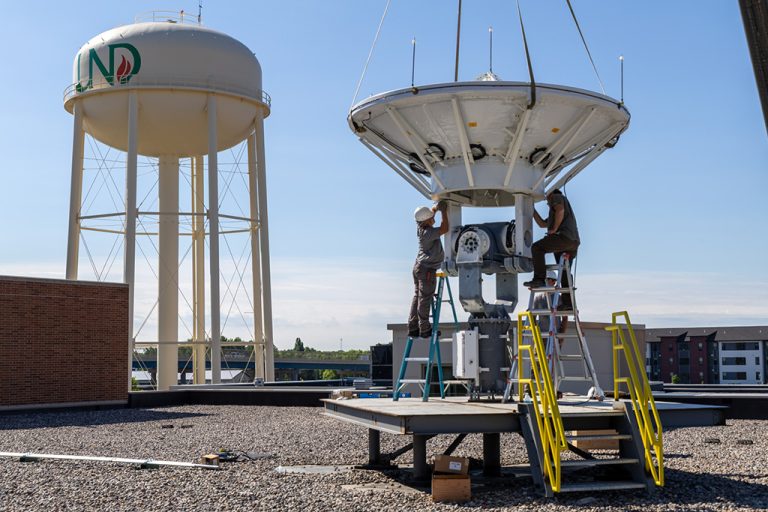
- John D. Odegard School of Aerospace Sciences (Space Studies and Aviation departments)
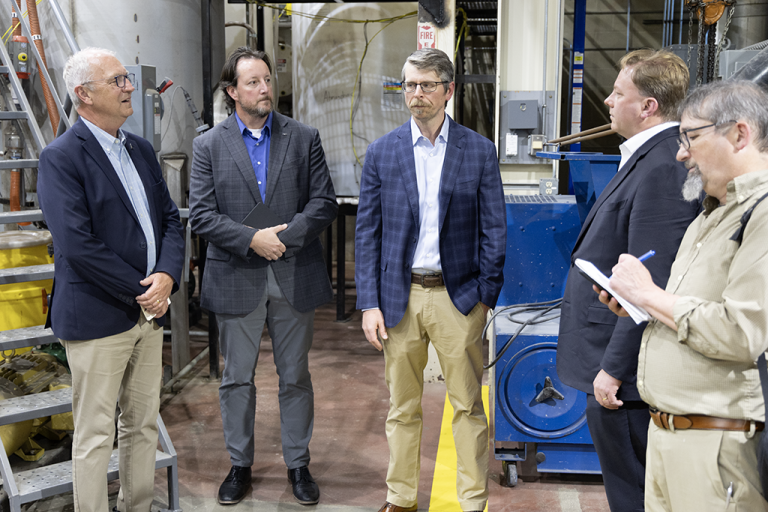
- College of Engineering & Mines (Electrical Engineering, Computer Science and Mechanical Engineering departments)
- The College of Engineering & Mines has been designated a National Center of Academic Excellence in Cyber Research (CAE-R) through 2029.
- College of Arts & Sciences (Chemistry, Mathematics, Physics & Astrophysics and Psychology/Human Factors departments)
- A new Nanofoundry for national security materials is developing advanced thin films for secure communications and quantum computing.
With emerging opportunities, the hope is that researchers and students from across campus can join and be supported on projects addressing known and yet unknown problems with multi-disciplinary solutions.
News