ICWA Family Preservation Program
ICWA Family Preservation (IFP) Program
The ICWA Family Preservation (IFP) Program is a statewide, collaborative initiative rooted in Tribal sovereignty and guided by the values of family, community, and cultural continuity. The program was developed through a grant funded by the Administration for Children and Families: Children’s Bureau, as part of the UND - Department of Social Work sponsored North Dakota ICWA Family Preservation Partnership. It was created in partnership with North Dakota Tribal Nations—the Mandan, Hidatsa and Arikara Nation; the Spirit Lake Nation; the Standing Rock Sioux Tribe; and the Turtle Mountain Band of Chippewa Indians—as well as the North Dakota Department of Health and Human Services (NDDHHS), Children and Family Services Section; the North Dakota Supreme Court’s Court Improvement Program; and the Native American Training Institute.
The IFP Program provides intensive, family-centered services to support Native American children and families at risk of separation. It is housed at the Native American Training Institute through a grant provided by the NDDHHS Children and Family Services Section and is under the leadership of IFP Program Director Jessi Leneaugh.
The Purpose
The IFP Program exists to honor the spirit and letter of the Indian Child Welfare Act (ICWA) by prioritizing prevention, family unity, and Tribal authority in decisions involving Indian children. The program seeks to:
-
Support the real-time accurate implementation of the Indian Child Welfare Act
-
Reduce the unnecessary removal of Native American children from their families and Tribal communities.
-
Strengthen family functioning through in-person support, early intervention, and coordinated care.
-
Ensure that “active efforts” are made from the earliest point of system involvement.
-
Uphold Tribal sovereignty and promote culturally appropriate service delivery.
How It Works
Each participating Tribal Nation identifies or partners with a the ICWA Family Preservationist Program. The assigned ICWA Family Preservationist works closely with families, Tribal representatives, and state agencies to provide wraparound services that reflect the needs, culture, and strengths of each family. Services may include:
-
In-home family support and coaching
-
Case coordination with Tribal and state systems
-
Connection to cultural and community-based resources
-
Advocacy to ensure ICWA compliance throughout the child welfare process
Statewide Reach
Initially piloted in selected counties, the IFP Program has now expanded statewide, with active implementation in multiple jurisdictions across North Dakota. Through ongoing training, technical assistance, and fidelity monitoring, the program continues to grow in its impact—demonstrating measurable improvements in family outcomes, reductions in disproportionality, and stronger partnerships between State and Tribal systems.
Centered on Tribal Voices
The IFP Program is guided by a statewide Partnership Design team including several Tribal and State partners, ensuring shared leadership and continuous learning. This structure allows the program to remain flexible, adaptive, and community-informed.
IFP Program Frequently Asked Questions
Official Tribal MOU Partners
The ICWA Family Preservation Program serves as an authorized representative only for Tribal Nations that have an active Memorandum of Understanding (MOU) with the Native American Training Institute (NATI). The directory below identifies the current Tribal MOU Partners and their designated ICWA contacts.
If there is Reason to Know that a child has a Tribal affiliation with one of the Tribal Nations listed below, the ICWA Inquiry Form should be sent to the appropriate Tribal ICWA contact and a copy should be provided to the ICWA Family Preservation Program by emailing Jessi Leneaugh at jessil@nativeinstitute.org.
Current Tribal MOU Partner Directory
IFP Program Information Brochure
Additional IFP Support for Native Families
The ICWA Family Preservation (IFP) Program may also provide support to Native American families who are not affiliated with a Tribal Nation that currently has a Memorandum of Understanding (MOU) with the Program.
At the request of the family, the IFP Program can provide information, guidance, resource connections, and support while partnering with families, agencies, and Tribal Nations to promote strong families and the accurate implementation of the Indian Child Welfare Act (ICWA), when applicable.
If you believe a family may benefit from IFP support, please review the referral resources below.
Agency Referral Guide
Learn when and how to refer a family to the ICWA Family Preservation Program.
IFP Support Referral Form
Complete this form to request IFP support for a family.
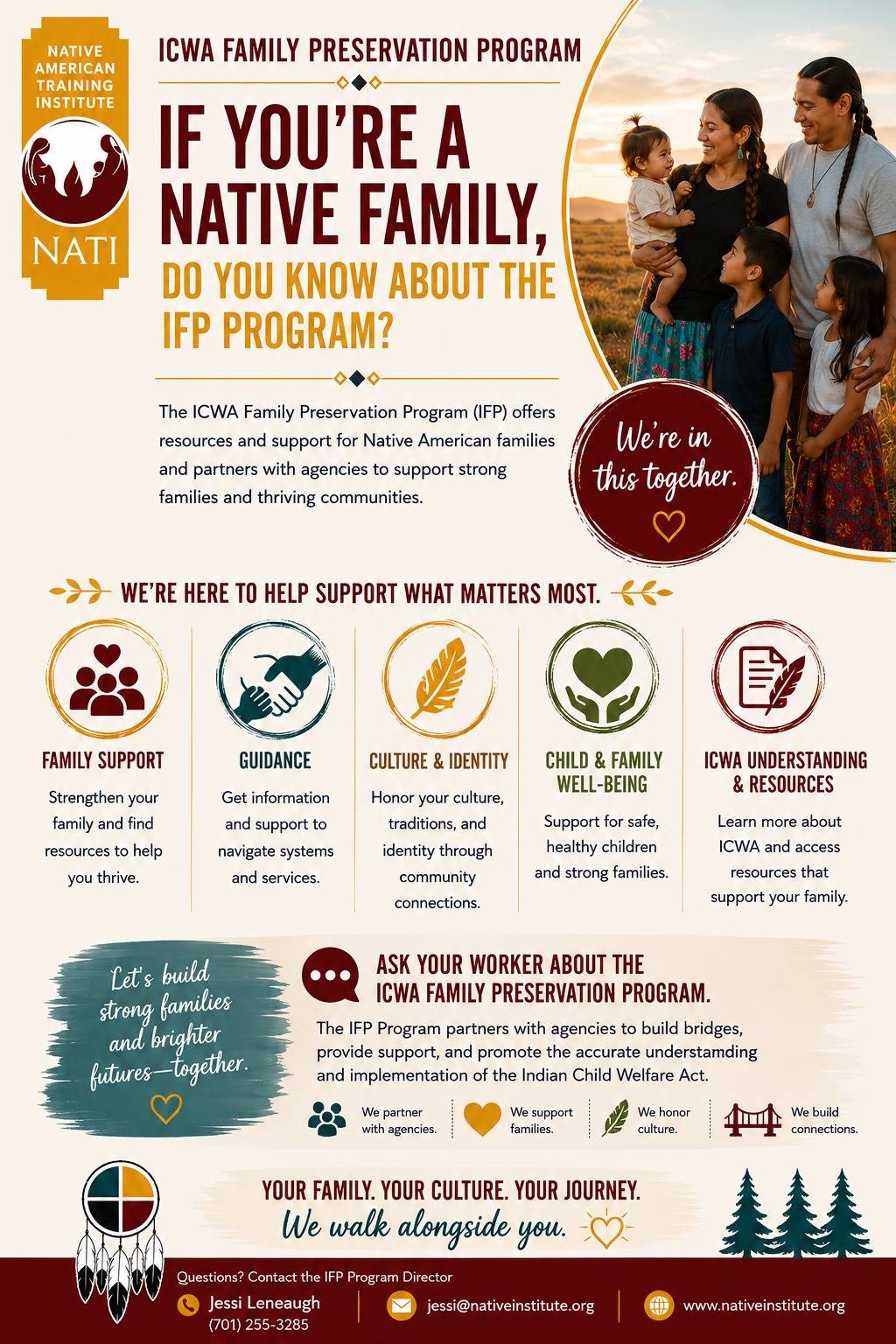
Family Information Flyer
Post this flyer in your agency to introduce the ICWA Family Preservation Program and
encourage families to ask their worker about available supports.