
Care Beyond Crisis
Austin Eskew didn't come to the University of North Dakota looking for a fresh start; he was looking for direction.
While pursuing his Master of Social Work at UND, he approached his studies with a clarity shaped by years of experience as a medic before returning to his studies.
His journey from the military to social work, and to UND, took shape over time, guided by a desire to continue serving others in meaningful ways.

Austin chose the social work career to support people through the journey of healing.
Working in high-pressure situations, Austin supported others through crisis while witnessing the emotional weight of trauma. These moments stayed with him, prompting him to consider what support looked like beyond the immediate medical response.
“I really enjoyed taking care of people,” he said. “But I didn’t want the responsibility of their lives on my hands anymore; that was too much pressure.”
This led Austin to social work, a field where he could redefine service as a commitment to long-term healing. Instead of responding only to immediate need, he saw an opportunity to support people through the longer journey of healing.
“I still wanted to be in a helping field,” he said. “But without that pressure.”
When you leave the program, you’re more than prepared for whatever field you’re going into.
It wasn’t about leaving service behind, but about redefining it — moving toward work that allowed space for empathy, understanding and lasting support for those navigating the depths of trauma.
Austin’s journey at UND began with his bachelor’s degree in social work, where the program quickly proved to be the right fit. As a nontraditional student in his 30s, he found a supportive environment grounded in real-world preparation. The faculty’s teaching style made continuing into the master’s program an easy choice.
There was no other option for me once I got here,”he said. “I liked the staff, the professors and the way they taught.”
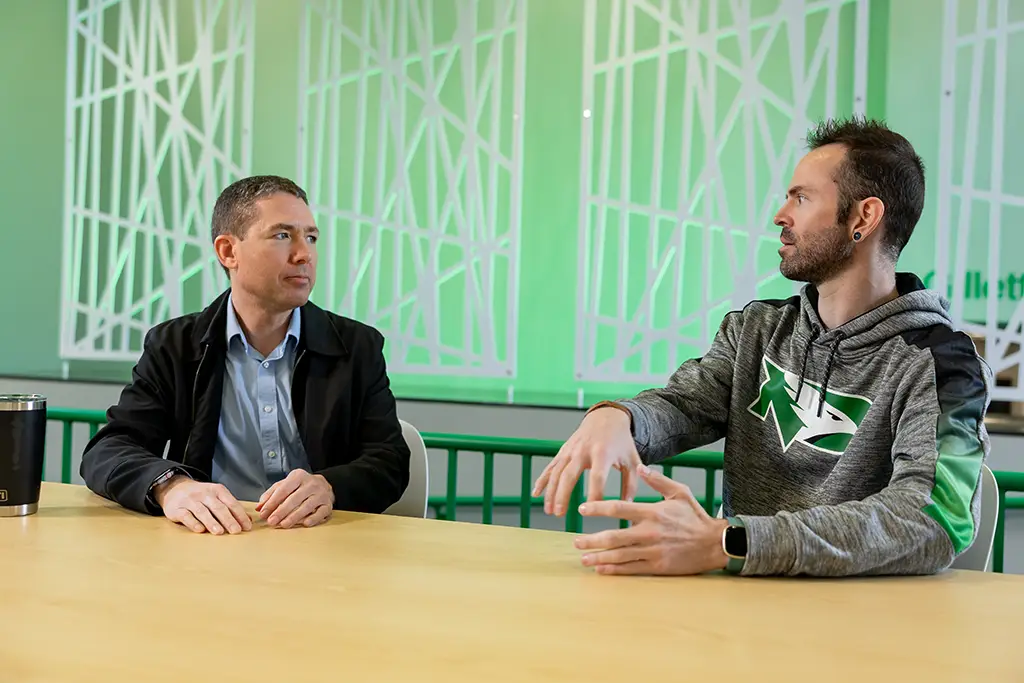
At UND, Austin found a supportive environment grounded in real-world preparation from numerous faculty members in the Social Work department.
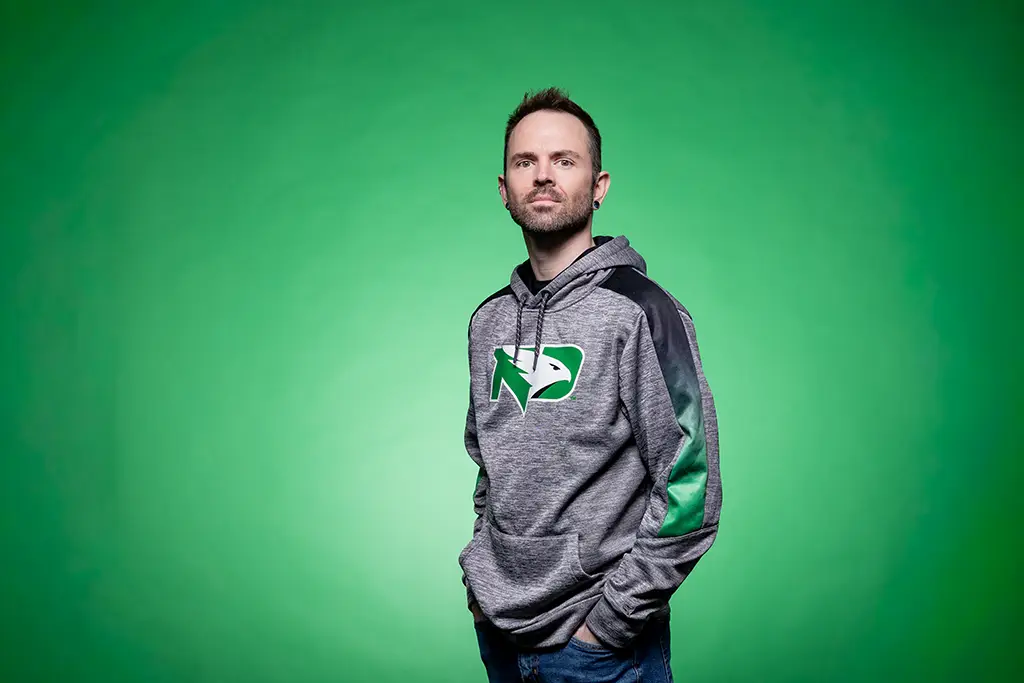
Austin's journey from the military to social work, and to UND, took shape over time, guided by a desire to continue serving others in meaningful ways.
Hands-on experience became an essential part of his studies. After a “life-changing” undergraduate internship in child protection, Austin moved into graduate clinical work at Birchwood Therapeutics while working full-time in the mental health field.
While in those roles, Austin learned that trust, patience and consistency often mattered just as much as clinical knowledge, reinforcing his belief that support happens through long-term relationships, not quick solutions
That emphasis on patience and sustained support didn’t stop in Austin’s clinical work; it began to also influence how he thought about care in a broad spectrum.
As he moved deeper into his graduate studies, those experiences shaped his academic interests, drawing him toward questions about dignity, compassion and how people are supported during life’s most vulnerable moments.
Austin’s graduate research delved into what’s known as the “Good Death Theory,” a philosophy centered on dignity and self-directed choice at the end of life. Though the topic may seem heavy, Austin’s perspective was rooted in optimism, seeing it as an extension of his advocacy in social work — a commitment to meeting people where they are.
“It's this belief that people should die with dignity, respect and as comfortably as possible,” he said.
For Austin, that idea resonated not as an abstract concept, but rather one focused on honoring the person behind the patient and validating their individual needs, cultural context and the importance of being heard, even in life’s final stages.
There was no other option for me once I got here. I liked the staff, the professors and the way they taught.
As he looks ahead to graduation, Austin’s goals remain rooted in service, just reimagined. He plans to work as a clinical therapist focusing on grief and trauma, particularly among military members, first responders and their families.Austin credits UND with preparing him both academically and practically.
“The expectations were higher, but they weren’t unreasonable,” he said. “When you leave the program, you’re more than prepared for whatever field you’re going into.”
While the setting of his service has changed, his commitment to supporting others with empathy and respect remains the same.