"Fables & Futures" Reading List
The 57th Annual UND Writers Conference, "Fables & Futures," features internationally recognized writers and artists whose work embraces the power of fables, fairy tales, folktales, and more to investigate our present and reimagine what the future holds.
Books by this year's Writers Conference authors will be available for purchase at the conference, sold by the UND Bookstore. Books will also be available for checkout by UND faculty, staff, and students at the Chester Fritz Library, and by community members at the Grand Forks Public Library.
Learn more about this year's featured authors and artists.
UND Writers Conference Reading List
Learn more about the books by this year's featured authors, or use the buttons below to jump directly to a selection of each author's books. All book descriptions are provided by the publishers and/or book retailers.
Selected Books by George Saunders
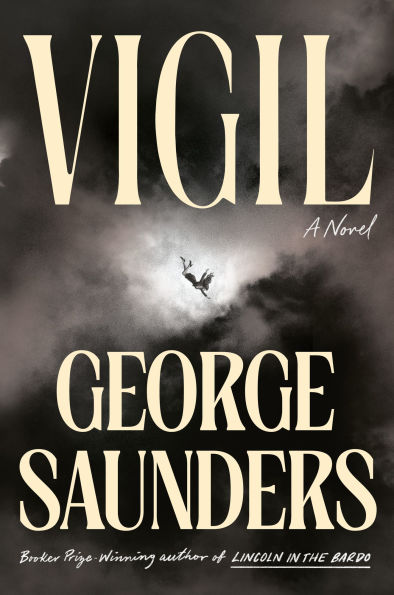
An electric novel from the #1 New York Times bestselling, Booker Prize–winning author of Lincoln in the Bardo, taking place at the bedside of an oil company CEO in the twilight hours of his life
as he is ferried from this world into the next.
Not for the first time, Jill “Doll” Blaine finds herself hurtling toward earth, reconstituting
as she falls, right down to her favorite black pumps. She plummets towards her newest
charge, yet another soul she must usher into the afterlife, and lands headfirst in
the circular drive of his ornate mansion.
She has performed this sacred duty 343 times since her own death. Her charges, as
a rule, have been greatly comforted in their final moments. But this charge, she soon
discovers, isn’t like the others. The powerful K. J. Boone will not be consoled, because
he has nothing to regret. He lived a big, bold, epic life, and the world is better
for it. Isn’t it?
Vigil transports us, careening, through the wild final evening of a complicated man. Visitors
begin to arrive (worldly and otherworldly, alive and dead), clamoring for a reckoning.
Birds swarm the dying man’s room; a black calf grazes on the love seat; a man from
a distant, drought-ravaged village materializes; two oil-business cronies from decades
past show up with chilling plans for Boone’s postdeath future.
With the wisdom, playfulness, and explosive imagination we’ve come to expect, George
Saunders takes on the gravest issues of our time—the menace of corporate greed, the
toll of capitalism, the environmental perils of progress—and, in the process, spins
a tale that encompasses life and death, good and evil, and the thorny question of
absolution.
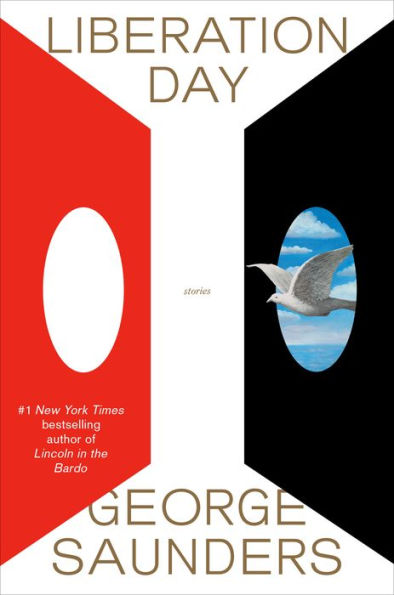
NEW YORK TIMES BESTSELLER • “One of our most inventive purveyors of the form returns with pitch-perfect,
genre-bending stories that stare into the abyss of our national character. . . . An
exquisite work from a writer whose reach is galactic.”—Oprah Daily
Booker Prize winner George Saunders returns with his first collection of short stories
since the New York Times bestseller Tenth of December.
ONE OF BARACK OBAMA’S FAVORITE BOOKS OF THE YEAR • ONE OF THE BEST BOOKS OF THE YEAR:
The New York Times Book Review, The New Yorker, Oprah Daily, NPR, Time, USA Today, The Guardian, Esquire, Newsweek, Kirkus Reviews, Booklist, Library
Journal
The “best short-story writer in English” (Time) is back with a masterful collection that explores ideas of power, ethics, and justice
and cuts to the very heart of what it means to live in community with our fellow humans.
With his trademark prose—wickedly funny, unsentimental, and exquisitely tuned—Saunders
continues to challenge and surprise: Here is a collection of prismatic, resonant stories
that encompass joy and despair, oppression and revolution, bizarre fantasy and brutal
reality.
“Love Letter” is a tender missive from grandfather to grandson, in the midst of a
dystopian political situation in the (not too distant, all too believable) future,
that reminds us of our obligations to our ideals, ourselves, and one another. “Ghoul”
is set in a Hell-themed section of an underground amusement park in Colorado and follows
the exploits of a lonely, morally complex character named Brian, who comes to question
everything he takes for granted about his reality. In “Mother’s Day,” two women who
loved the same man come to an existential reckoning in the middle of a hailstorm.
In “Elliott Spencer,” our eighty-nine-year-old protagonist finds himself brainwashed,
his memory “scraped”—a victim of a scheme in which poor, vulnerable people are reprogrammed
and deployed as political protesters. And “My House”—in a mere seven pages—comes to
terms with the haunting nature of unfulfilled dreams and the inevitability of decay.
Together, these nine subversive, profound, and essential stories coalesce into a case
for viewing the world with the same generosity and clear-eyed attention Saunders does,
even in the most absurd of circumstances.
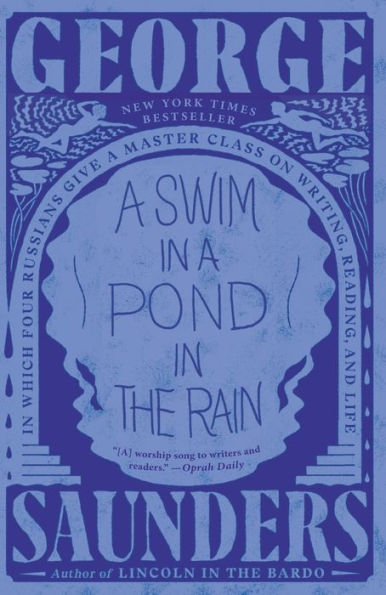
NEW YORK TIMES BESTSELLER • From the Booker Prize–winning author of Lincoln in the Bardo andTenth of December comes a literary master class on what makes great stories work and what they can
tell us about ourselves—and our world today.
LONGLISTED FOR THE PEN/DIAMONSTEIN-SPIELVOGEL AWARD • ONE OF THE BEST BOOKS OF THE
YEAR: The Washington Post, NPR, Time, San Francisco Chronicle, Esquire, Milwaukee Journal Sentinel, Town & Country, The Rumpus, Electric Lit, Thrillist, BookPage
“[A] worship song to writers and readers.”—Oprah Daily, "Best Nonfiction Books of the Past Two Decades"
For the last twenty years, George Saunders has been teaching a class on the Russian
short story to his MFA students at Syracuse University. In A Swim in a Pond in the Rain, he shares a version of that class with us, offering some of what he and his students
have discovered together over the years. Paired with iconic short stories by Chekhov,
Turgenev, Tolstoy, and Gogol, the seven essays in this book are intended for anyone
interested in how fiction works and why it’s more relevant than ever in these turbulent
times.
In his introduction, Saunders writes, “We’re going to enter seven fastidiously constructed
scale models of the world, made for a specific purpose that our time maybe doesn’t
fully endorse but that these writers accepted implicitly as the aim of art—namely,
to ask the big questions, questions like, How are we supposed to be living down here?
What were we put here to accomplish? What should we value? What is truth, anyway,
and how might we recognize it?” He approaches the stories technically yet accessibly,
and through them explains how narrative functions; why we stay immersed in a story
and why we resist it; and the bedrock virtues a writer must foster. The process of
writing, Saunders reminds us, is a technical craft, but also a way of training oneself
to see the world with new openness and curiosity.
A Swim in a Pond in the Rain is a deep exploration not just of how great writing works but of how the mind itself
works while reading, and of how the reading and writing of stories make genuine connection
possible.
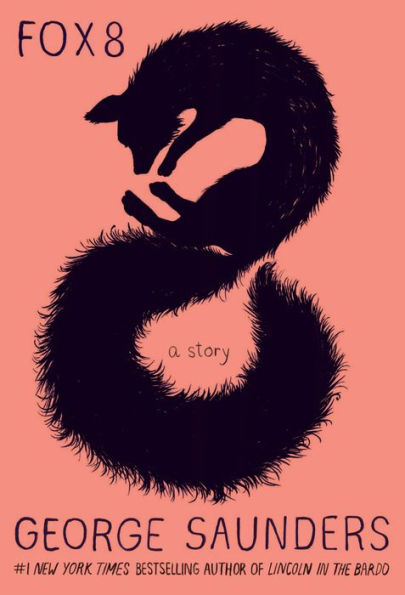
From the #1 New York Times bestselling author of Lincoln in the Bardo, a darkly comic short story about the unintended consequences unleashed by our quest
to tame the natural world—featuring gorgeous black-and-white illustrations by Chelsea
Cardinal.
Fox 8 has always been known as the daydreamer in his pack, the one his fellow foxes
regard with a knowing snort and a roll of the eyes. That is, until he develops a unique
skill: He teaches himself to speak “Yuman” by hiding in the bushes outside a house
and listening to children’s bedtime stories. The power of language fuels his abundant
curiosity about people—even after “danjer” arrives in the form of a new shopping mall
that cuts off his food supply, sending Fox 8 on a harrowing quest to help save his
pack.
Told with his distinctive blend of humor and pathos, Fox 8 showcases the extraordinary imaginative talents of George Saunders, whom The New York Times called “the writer for our time.”
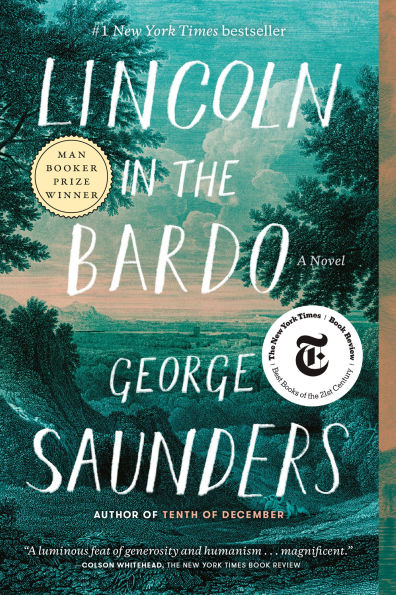
#1 NEW YORK TIMES BESTSELLER • WINNER OF THE MAN BOOKER PRIZE
The “devastatingly moving” (People) first novel from the author of Tenth of December: a moving and original father-son story featuring none other than Abraham Lincoln,
as well as an unforgettable cast of supporting characters, living and dead, historical
and invented
One of The New York Times’s 100 Best Books of the 21st Century • One of The Atlantic’s Great American Novels of the Past 100 Years • One of Paste’s Best Novels of the Decade
Named One of the Ten Best Books of the Year by The Washington Post, USA Today, and Maureen Corrigan, NPR • One of Time’s Ten Best Novels of the Year • A New York Times Notable Book • One of O: The Oprah Magazine’s Best Books of the Year
February 1862. The Civil War is less than one year old. The fighting has begun in
earnest, and the nation has begun to realize it is in for a long, bloody struggle.
Meanwhile, President Lincoln’s beloved eleven-year-old son, Willie, lies upstairs
in the White House, gravely ill. In a matter of days, despite predictions of a recovery,
Willie dies and is laid to rest in a Georgetown cemetery. “My poor boy, he was too
good for this earth,” the president says at the time. “God has called him home.” Newspapers
report that a grief-stricken Lincoln returns, alone, to the crypt several times to
hold his boy’s body.
From that seed of historical truth, George Saunders spins an unforgettable story of
familial love and loss that breaks free of its realistic, historical framework into
a supernatural realm both hilarious and terrifying. Willie Lincoln finds himself in
a strange purgatory where ghosts mingle, gripe, commiserate, quarrel, and enact bizarre
acts of penance. Within this transitional state—called, in the Tibetan tradition,
the bardo—a monumental struggle erupts over young Willie’s soul.
Lincoln in the Bardo is an astonishing feat of imagination and a bold step forward from one of the most
important and influential writers of his generation. Formally daring, generous in
spirit, deeply concerned with matters of the heart, it is a testament to fiction’s
ability to speak honestly and powerfully to the things that really matter to us. Saunders
has invented a thrilling new form that deploys a kaleidoscopic, theatrical panorama
of voices to ask a timeless, profound question: How do we live and love when we know
that everything we love must end?
“A luminous feat of generosity and humanism.”
—Colson Whitehead, The New York Times Book Review
“A masterpiece.”
—Zadie Smith
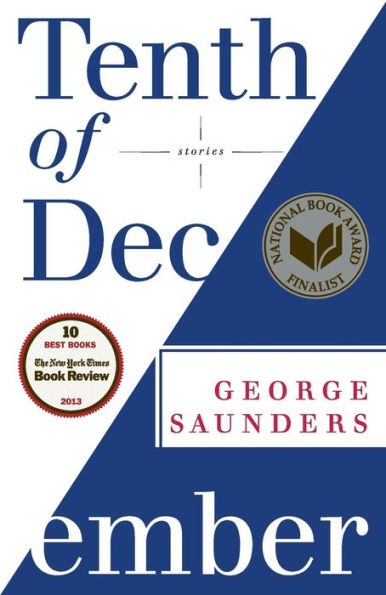
NEW YORK TIMES BESTSELLER • NATIONAL BOOK AWARD FINALIST • NAMED ONE OF TIME’STEN BEST FICTION BOOKS OF THE DECADE • NAMED ONE OF THE BEST BOOKS OF THE DECADE BY
ENTERTAINMENT WEEKLY AND BUZZFEED • NAMED ONE OF THE TEN BEST BOOKS OF THE YEAR BY THE NEW YORK TIMES BOOK REVIEW
One of the New York Times’s 100 Best Books of the 21st Century
A BEST BOOK OF THE YEAR: People, The New York Times Magazine, NPR, Entertainment Weekly, New York, The Telegraph, BuzzFeed, Kirkus Reviews, BookPage,
Shelf Awareness
One of the most important and blazingly original writers of his generation, George
Saunders is an undisputed master of the short story, and Tenth of December is his most honest, accessible, and moving collection yet.
In the taut opener, “Victory Lap,” a boy witnesses the attempted abduction of the
girl next door and is faced with a harrowing choice: Does he ignore what he sees,
or override years of smothering advice from his parents and act? In “Home,” a combat-damaged
soldier moves back in with his mother and struggles to reconcile the world he left
with the one to which he has returned. And in the title story, a stunning meditation
on imagination, memory, and loss, a middle-aged cancer patient walks into the woods
to commit suicide, only to encounter a troubled young boy who, over the course of
a fateful morning, gives the dying man a final chance to recall who he really is.
A hapless, deluded owner of an antiques store; two mothers struggling to do the right
thing; a teenage girl whose idealism is challenged by a brutal brush with reality;
a man tormented by a series of pharmaceutical experiments that force him to lust,
to love, to kill—the unforgettable characters that populate the pages of Tenth of December are vividly and lovingly infused with Saunders’s signature blend of exuberant prose,
deep humanity, and stylistic innovation.
Writing brilliantly and profoundly about class, sex, love, loss, work, despair, and
war, Saunders cuts to the core of the contemporary experience. These stories take
on the big questions and explore the fault lines of our own morality, delving into
the questions of what makes us good and what makes us human.
Unsettling, insightful, and hilarious, the stories in Tenth of December—through their manic energy, their focus on what is redeemable in human beings, and
their generosity of spirit—not only entertain and delight; they fulfill Chekhov’s
dictum that art should “prepare us for tenderness.”
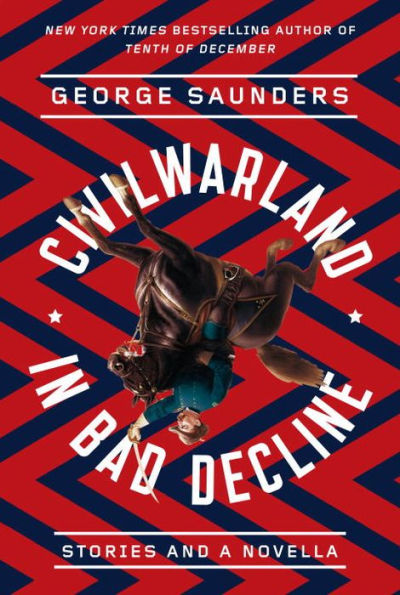
Since its publication in 1996, George Saunders’s debut collection has grown in esteem
from a cherished cult classic to a masterpiece of the form, inspiring an entire generation
of writers along the way. In six stories and a novella, Saunders hatches an unforgettable
cast of characters, each struggling to survive in an increasingly haywire world. With
a new introduction by Joshua Ferris and a new author’s note by Saunders himself, this
edition is essential reading for those seeking to discover or revisit a virtuosic,
disturbingly prescient voice.
Praise for George Saunders and CivilWarLand in Bad Decline
“It’s no exaggeration to say that short story master George Saunders helped change
the trajectory of American fiction.”
—The Wall Street Journal
“Saunders’s satiric vision of America is dark and demented; it’s also ferocious and
very funny.”
—Michiko Kakutani, The New York Times
“George Saunders is a writer of arresting brilliance and originality, with a sure
sense of his material and apparently inexhaustible resources of voice. [CivilWarLand in Bad Decline] is scary, hilarious, and unforgettable.”
—Tobias Wolff
“Saunders makes the all-but-impossible look effortless.”
—Jonathan Franzen
“Not since Twain has America produced a satirist this funny.”
—Zadie Smith
“An astoundingly tuned voice—graceful, dark, authentic, and funny—telling just the
kinds of stories we need to get us through these times.”
—Thomas Pynchon
Books by Maria Dahvana Headley
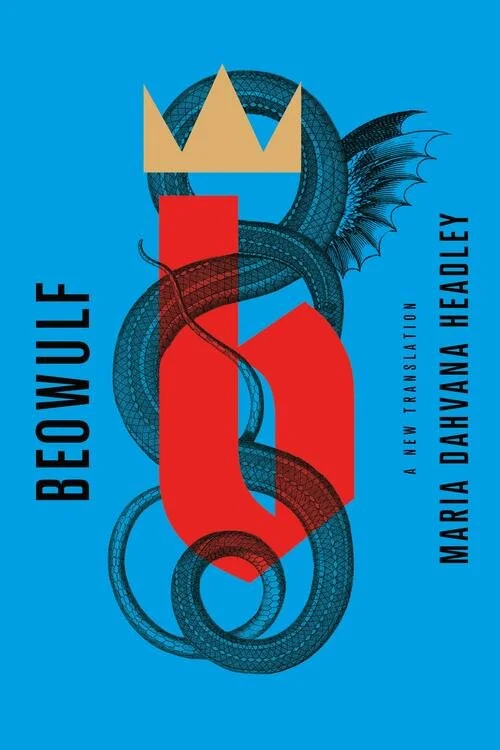
Named one of the Best Poetry Books of 2021 by The Guardian
Longlisted for the 2021 National Translation Award in Poetry. Picked for Kirkus Reviews’ Best Fiction in Translation of 2020. Named a Book of the Year by NPR, Vox, and The New Statesman. Picked for Loyalty Books’ Holiday List.
A new, feminist translation of Beowulf by the author of the much-buzzed-about novel The Mere Wife
"Brash and belligerent, lunatic and invigorating, with passages of sublime poetry punctuated
by obscenities and social-media shorthand."
–Ruth Franklin, The New Yorker
"The author of the crazy-cool Beowulf-inspired novel The Mere Wife tackles the Old English epic poem with a fierce new feminist translation that radically
recontextualizes the tale."
–Barbara VanDenburgh, USA Today
Nearly twenty years after Seamus Heaney’s translation of Beowulf—and fifty years after the translation that continues to torment high-school students around the world—there is a radical new verse translation of the epic poem by Maria Dahvana Headley, which brings to light elements that have never before been translated into English, recontextualizing the binary narrative of monsters and heroes into a tale in which the two categories often entwine, justice is rarely served, and dragons live among us.
A man seeks to prove himself as a hero. A monster seeks silence in his territory. A warrior seeks to avenge her murdered son. A dragon ends it all. The familiar elements of the epic poem are seen with a novelist’s eye toward gender, genre, and history—Beowulf has always been a tale of entitlement and encroachment, powerful men seeking to become more powerful, and one woman seeking justice for her child, but this version brings new context to an old story. While crafting her contemporary adaptation of Beowulf, Headley unearthed significant shifts lost over centuries of translation.
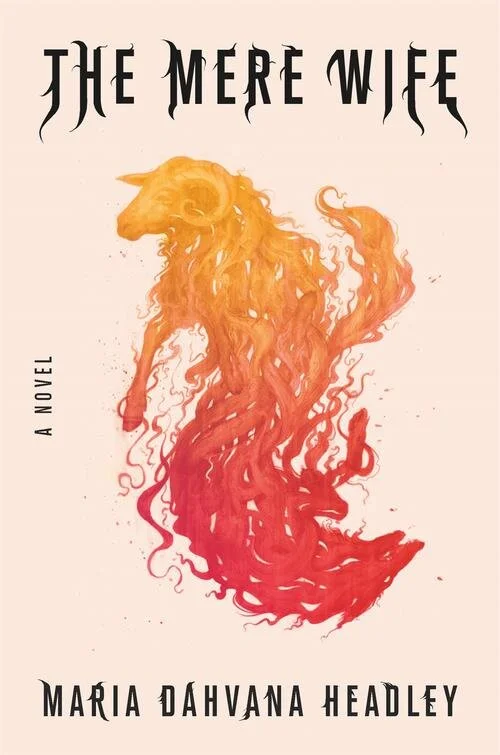
New York Times bestselling author Maria Dahvana Headley presents a modern retelling of the literary
classic Beowulf, set in American suburbia as two mothers—a housewife and a battle-hardened veteran—fight
to protect those they love in The Mere Wife.
From the perspective of those who live in Herot Hall, the suburb is a paradise. Picket
fences divide buildings—high and gabled—and the community is entirely self-sustaining.
Each house has its own fireplace, each fireplace is fitted with a container of lighter
fluid, and outside—in lawns and on playgrounds—wildflowers seed themselves in neat
rows. But for those who live surreptitiously along Herot Hall’s periphery, the subdivision
is a fortress guarded by an intense network of gates, surveillance cameras, and motion-activated
lights.
For Willa, the wife of Roger Herot (heir of Herot Hall), life moves at a charmingly
slow pace. She flits between mommy groups, playdates, cocktail hour, and dinner parties,
always with her son, Dylan, in tow. Meanwhile, in a cave in the mountains just beyond
the limits of Herot Hall lives Gren, short for Grendel, as well as his mother, Dana,
a former soldier who gave birth as if by chance. Dana didn’t want Gren, didn’t plan
Gren, and doesn’t know how she got Gren, but when she returned from war, there he
was. When Gren, unaware of the borders erected to keep him at bay, ventures into Herot
Hall and runs off with Dylan, Dana’s and Willa’s worlds collide.
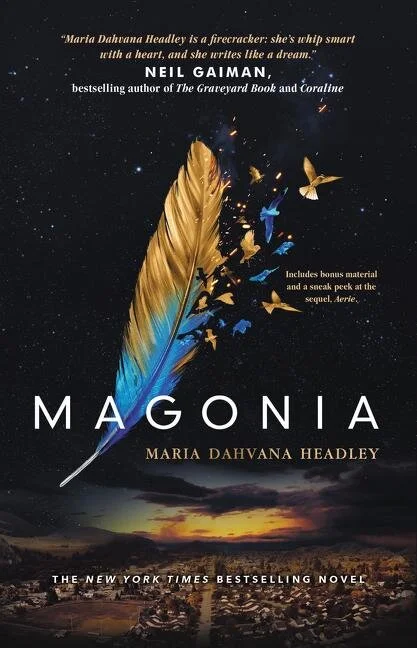
#1 New York Times bestseller Maria Dahvana Headley’s soaring sky fantasy Magonia is now in paperback!
Aza Ray Boyle is drowning in thin air. Since she was a baby, Aza has suffered from a mysterious lung disease that makes it ever harder for her to breathe, to speak—to live.
So when Aza catches a glimpse of a ship in the sky, her family chalks it up to a cruel side effect of her medication. But Aza doesn't think this is a hallucination. She can hear someone on the ship calling her name.
Only her best friend, Jason, listens. Jason, who's always been there. Jason, for whom she might have more-than-friendly feelings. But before Aza can consider that thrilling idea, something goes terribly wrong. Aza is lost to our world—and found, by another. Magonia.
Above the clouds, in a land of trading ships, Aza is not the weak and dying thing she was. In Magonia, she can breathe for the first time. Better, she has immense power—but as she navigates her new life, she discovers that war between Magonia and Earth is coming. In Aza's hands lies fate of the whole of humanity—including the boy who loves her. Where do her loyalties lie?
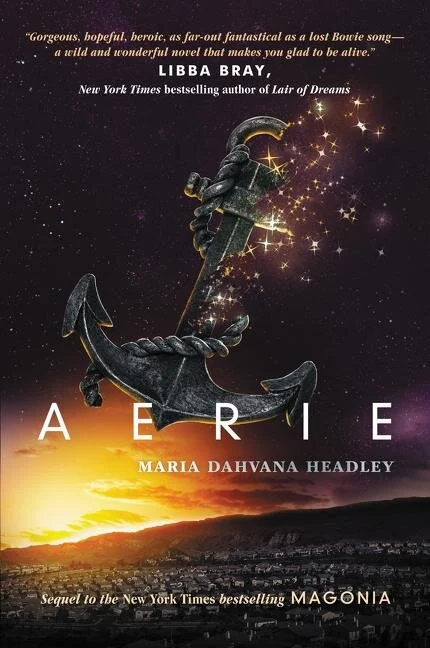
The stunning sequel to Maria Dahvana Headley’s bestselling, critically acclaimed Magonia tells the story of one girl who must make an impossible choice between two families, two homes—and two versions of herself.
Aza Ray is back on earth. Her boyfriend, Jason, is overjoyed. Her family is healed. She’s living a normal life, or as normal as it can be if you’ve spent the past year dying, waking up on a sky ship, and discovering that your song can change the world.
As in, not normal. Part of Aza still yearns for the clouds, no matter how much she loves the people on the ground.
When Jason’s paranoia over Aza’s safety causes him to make a terrible mistake, Aza finds herself a fugitive in Magonia, tasked with opposing her radical, bloodthirsty, recently escaped mother, Zal Quel, and her singing partner, Dai. She must travel to the edge of the world in search of a legendary weapon, the Flock, in a journey through fire and identity that will transform her forever.
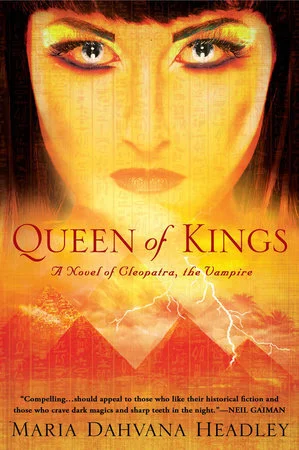
In this stunningly original debut, go beyond the legend of Queen Cleopatra and discover
a passion steeped in the bloodlust of vampires…
The year is 30 BC. A messenger delivers word to Queen Cleopatra that her beloved husband,
Antony, has died at his own hand. Desperate to save her kingdom, Cleopatra strikes
a mortal bargain in exchange for Antony’s soul, transforming her into an immortal—a
vampire with superhuman strength and an insatiable hunger for blood.
Leaving a trail of fiery retribution, Cleopatra journeys from the tombs of Egypt to
the ancient underworld in order to meet her husband again. But to resurrect him, Cleopatra
will need to challenge mythical beings with power beyond comprehension—risking the
fate of both this world and the next for a love that will not die…
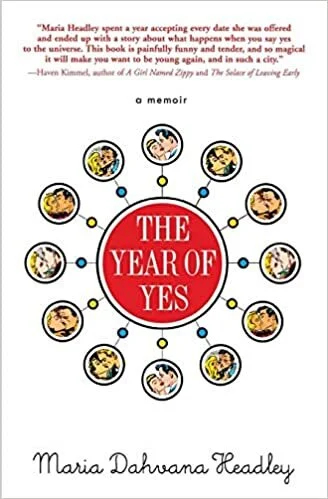
The "poignant and hilarious" (Newsday) story of one woman's twelve months of dating anyone—absolutely anyone—who asked her out.
At some point every woman who's single (and not by choice) wonders whether she's not somehow responsible for her predicament. Is she too choosy? Should she have given that guy with the combover and the mother issues a shot? Maybe three full feet isn't too much of a height difference . . .? Maria Dahvana Headley had been there, cherry-picking the men shed dated based on a variety of criteria, and clearly it wasn't getting her anywhere.
The Year of Yes is the hilarious and hopeful account of Headley's quest to find a man she could stand (for longer than a couple of hours). Frustrated by her own ineffective taste, she resolved to leave her love life up to fate, dating anyone who asked her: homeless men, a millionaire, several non-English speakers, a mime, and even two women. And finally, one man whose baggage would have disqualified him in any other year . . . but this was the Year of Yes, when Headley would finally discover what was really important.
RETURN TO THE TOP OF THE PAGE
Books by Anna Maria Hong
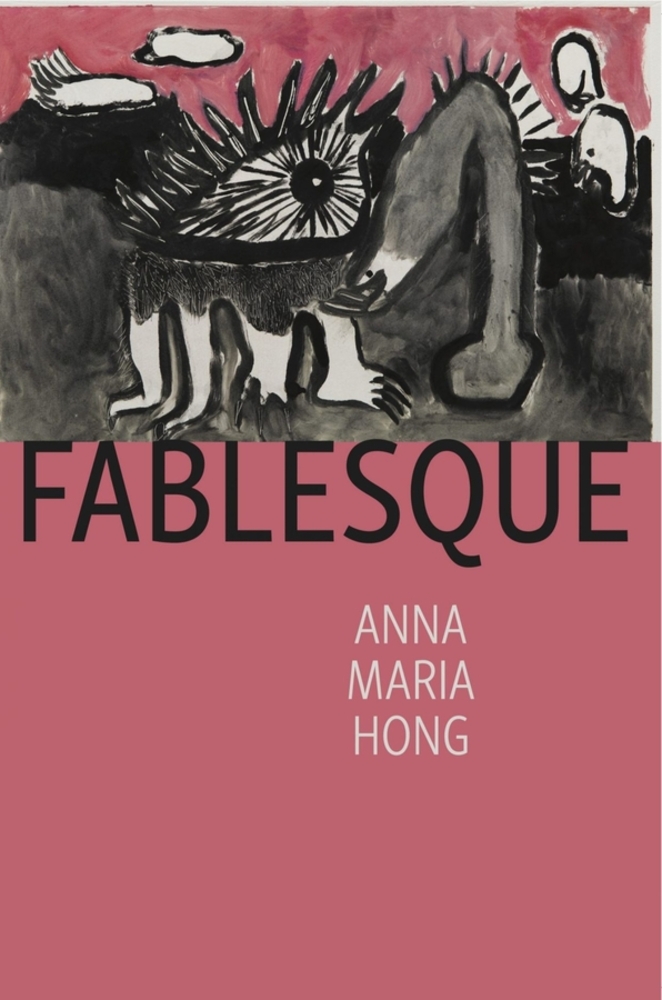
A hybrid-genre carnivalesque of trauma and rebirth, Fablesque harnesses the power of old tales to dispel the disenchantments of women and animals in the #MeToo era. Blending fiction and myth, personal essay, prose poetry and verse, and spanning scales from local to celestial, channeling voices of the voiceless and the mighty, Fablesque speaks to the apocalyptic moment of the present.
Harnessing folktale, fairy tale, and collage, the poems embrace constraint as a starting point for liberating new content and for addressing constructions and intersections of gender, race, power, and time. The collection embraces the great feminist tradition of retelling old tales to imbue them with female subjectivity, speaking to the thoughts, desires, and outrages of contemporary American women.
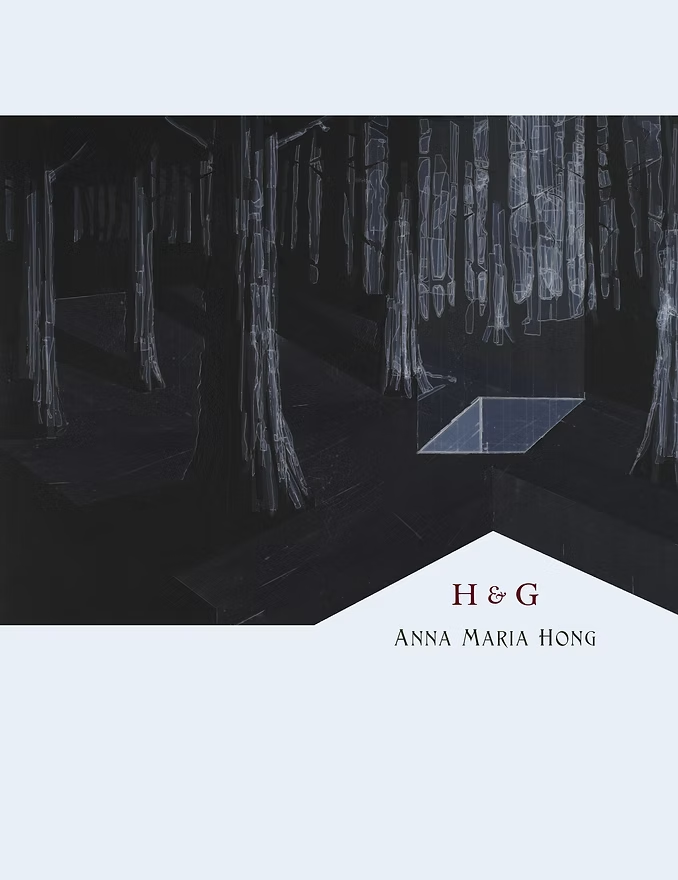
In this hybrid novella of trauma and survival, Anna Maria Hong re-imagines and extends the tale of Hansel and Gretel, breaking its received patterns of abandonment and abuse to set G. to wander a world racialized and gendered by power dynamics at every turn. Survivor, artist, hero, G.'s decisive action at the Witch's oven becomes the kernel of a new identity, independent and resilient, capable of transforming cruel stories into a cunning, masterful feminist Bildungsroman.
Praise for H & G:
"In H & G, Anna Maria Hong brilliantly re-visions the 'Hansel and Gretel' fairytale for the
post-post-modern 21st century. Or explodes it, producing a text brimming with biting
wit, feminist insight, psychological incisiveness, and a hybrid narrative daring that
turns genre on its head. G., a 'Korean American fraülein' who is 'sick of the high
road' is willing to tear the whole fantasy edifice of our illusions down as she journeys
toward deeper truths, and thankfully, she and H. take us along for their sometimes-frightening,
always enlightening rides."
–John Keene
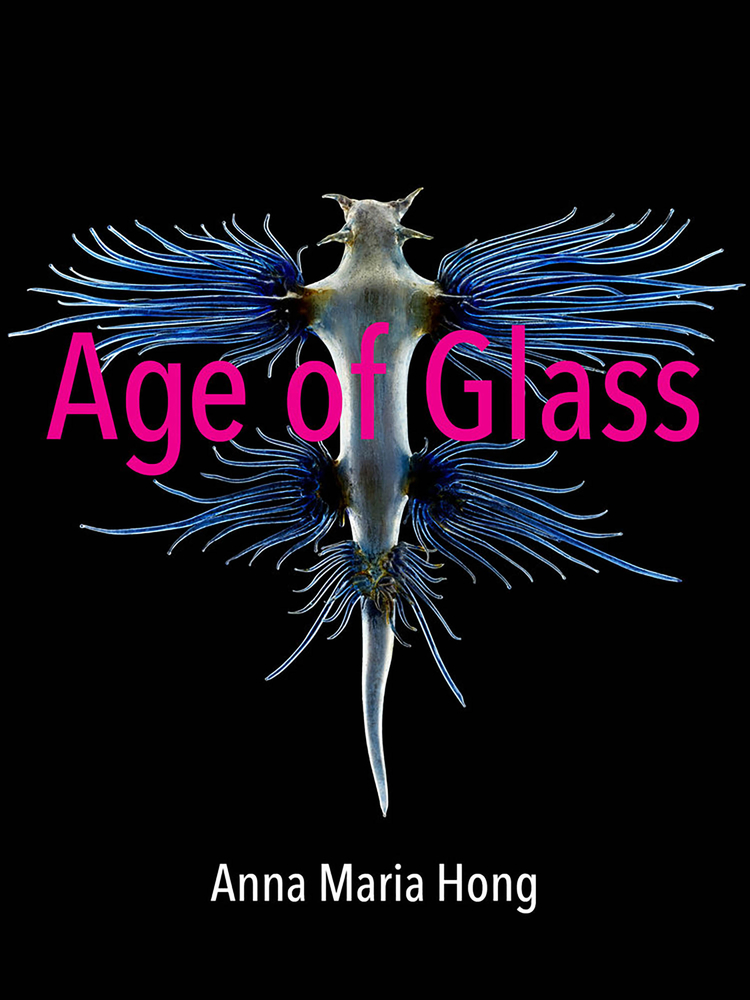
Winner of the 2017 CSU Poetry Center First Book Competition, selected by Suzanne Buffam
Winner of the Poetry Society of America's Norma Farber First Book Award, 2019
Praise for Age of Glass:
““The engine of alchemy / was rage. The small man's history of winning / was long
but irrelevant,” remarks Anna Maria Hong midway through Age of Glass. This caustic suite of ludic sonnets upcycles old stories—myths, fairytales, fables,
clichés—into bright, prismatic spells for the end of days. “Slant reuses / the cant
of the box,” the canny speaker incants. “A palindrome pulse / recalibrates luck.”
Open this book to any page and you'll be met with lines so timely, so tonic, and so
lexically dexterous you'll feel enchanted, however fleetingly, to cohabit this age.”
—Suzanne Buffam
“Like the 17th-century Mexican poet Sor Juana Inés de la Cruz, whose sonnets echo
and upstage a notably male and European literary tradition, Anna Maria Hong demonstrates
in her own labyrinthine sonnets 'the monstrous breadth' of her poetic abilities, offering
in them radical interpretations of myths and fairy tales that speak to our time and
dazzle us with their wit and linguistic virtuosity. No one is writing like Anna Maria
Hong in this Age of Glass.”
–Rosa Alcalá
“Anna Maria Hong's poems—in this case a book of astoundingly innovative sonnets—confirm
to us the credo we store in our hearts: that with intelligence, musicality and a love
of language poetry can make any subject compelling and revelatory. But it takes a
poet with a rare talent like Anna Maria Hong to make us see and joyously declaim what
we believe. Age of Glass is a book I've been hoping to read for a long time, from a poet whose work I’ve admired
for a longer time."
–Khaled Mattawa
RETURN TO THE TOP OF THE PAGE
Books by Megan Kamalei Kakimoto
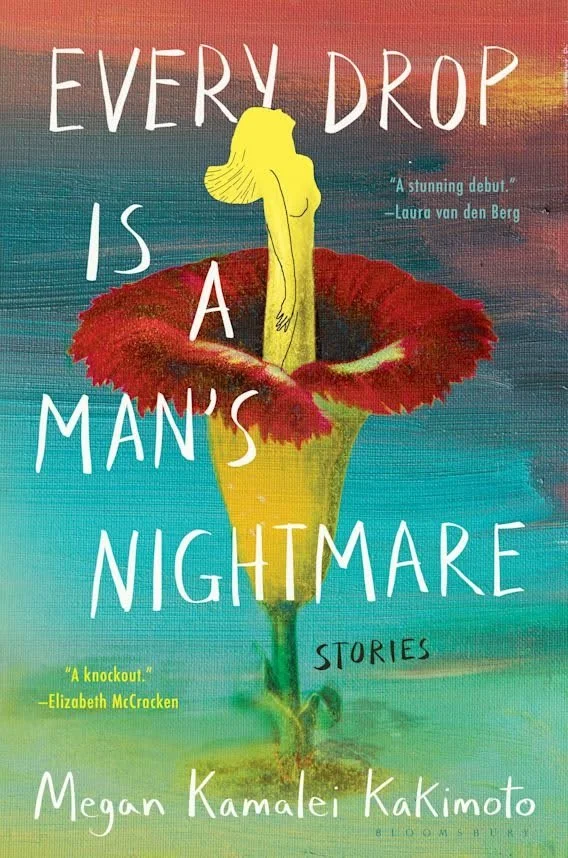
USA Today Bestseller
A Debutiful “Best Debuts of the Year”
“Rich and wise, humming with confidence.” -New York Times Book Review
“A knockout. Eleven knockouts. One KO for every story.”-Elizabeth McCracken
“Every Drop Is a Man's Nightmare is a frontrunner for Book of the Year.” -Debutiful
From major new storytelling talent Megan Kamalei Kakimoto, a blazing, bodily, raucous journey through contemporary Hawaiian identity and womanhood.
Megan Kamalei Kakimoto's wrenching and sensational debut story collection follows a cast of mixed native Hawaiian and Japanese women through a contemporary landscape thick with inherited wisdom and the ghosts of colonization. This is a Hawaii where unruly sexuality and generational memory overflow the postcard image of paradise and the boundaries of the real, where the superstitions born of the islands take on the weight of truth.
A childhood encounter with a wild pua'a (pig) on the haunted Pali highway portends one young woman's fraught relationship with her pregnant body. An elderly widow begins seeing her deceased lover in a giant flower. A kanaka writer, mid-manuscript, feels her raw pages quaking and knocking in the briefcase.
Every Drop Is a Man's Nightmare is both a fierce love letter to Hawaiian identity and mythology, and a searing dispatch from an occupied territory threatening to erupt with violent secrets.
Books by Ananda Lima
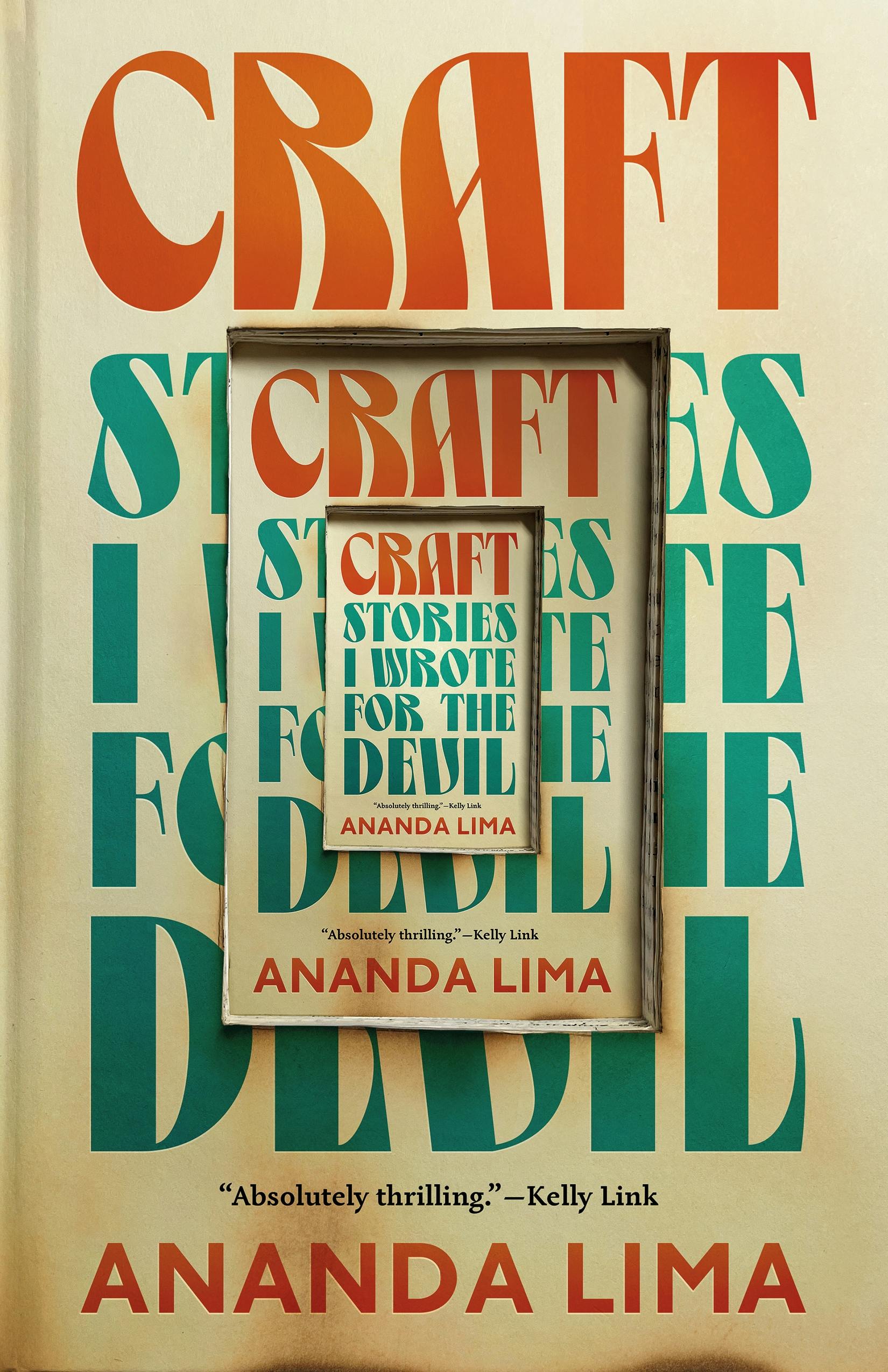
Strange, intimate, haunted, and hungry—Craft: Stories I Wrote for the Devil is an intoxicating and surreal fiction debut by award-winning author Ananda Lima.
"Remarkable and memorable."
—OLIVIE BLAKE
“An astounding new voice.”
—ERIC LaROCCA
"I love it so much.”
—KELLY LINK
“Trippy, eerie, wry, and always profound.”
—JOHN KEENE
“Incredible. Truly wondrous.”
—KEVIN WILSON
"Heart-wrenching and wickedly funny."
—GWEN KIRBY
“Propulsive, uncanny, and expertly built.”
—JULIA FINE
At a Halloween party in 1999, a writer slept with the devil. She sees him again and
again throughout her life and she writes stories for him about things that are both
impossible and true.
Lima lures readers into surreal pockets of the United States and Brazil where they’ll
find bite-size Americans in vending machines and the ghosts of people who are not
dead. Once there, she speaks to modern Brazilian-American immigrant experiences–of
ambition, fear, longing, and belonging—and reveals the porousness of storytelling
and of the places we call home.
With humor, an exquisite imagination, and a voice praised as “singular and wise and
fresh” (Cathy Park Hong), Lima joins the literary lineage of Bulgakov and Lispector
and the company of writers today like Ted Chiang, Carmen Maria Machado, and Nana Kwame
Adjei-Brenyah.
Craft: Stories I Wrote for the Devil includes: “Rapture,” “Ghost Story,” “Tropicália,” “Antropógaga,” “Idle Hands,” “Rent,”
“Porcelain,” “Heaven, Hell, and Purgatory,” and “Hasselblad.”
A great next read for fans of Carmen Maria Machado's Her Body and Other Parties and V. E. Schwab's The Invisible Life of Addie LaRue.
Recommended reading by Chicago Review of Books, Electric Literature, The Kenyon Review, and more!
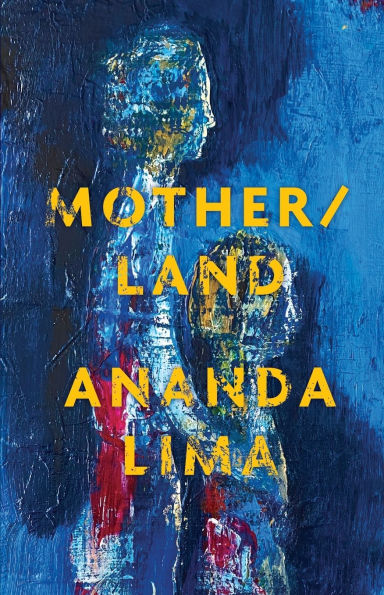
Mother/land, winner of the 2020 Hudson Prize, is focused on the intersection of motherhood and immigration and its effects on a speaker’s relationship to place, others and self. It investigates the mutual and compounding complications of these two shifts in identity while examining legacy, history, ancestry, land, home, and language. The collection is heavily focused on the latter, including formal experimentation with hybridity and polyvocality, combining English and Portuguese, interrogating translation and transforming traditional repeating poetic forms. These poems from the perspective of an immigrant mother of an American child create a complex picture of the beauty, danger and parental love the speaker finds and the legacy she brings to her reluctant new motherland.
Selected Books by Roque Raquel Salas Rivera
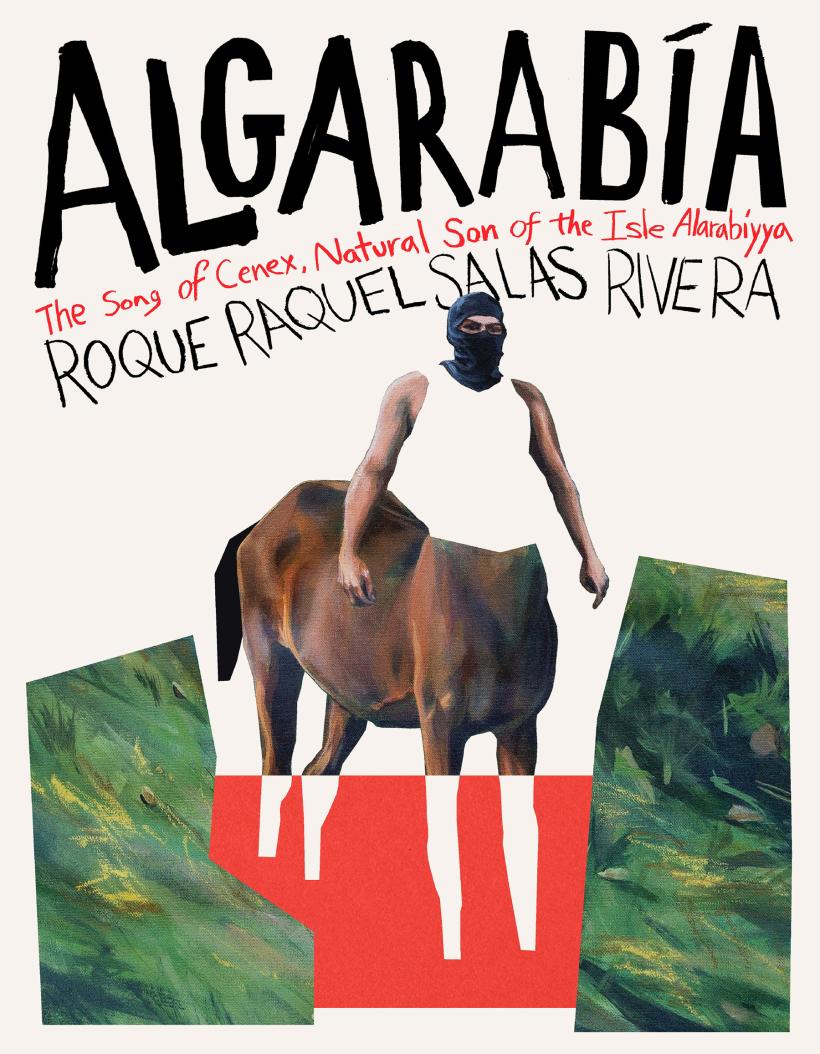
Algarabía is an epic poem that follows the journey of Cenex, a trans being who retrospectively
narrates his life while navigating the stories told on his behalf.
An inhabitant of Algarabía, a colony of Earth in a parallel universe, Cenex struggles
to find a name, a body, and a stable home. The song of Cenex weaves and clashes texts
by cis writers on trans figures with fragments from historical, legal, and other nonliterary
texts. Cenex leads us through his childhood hospitalization, his years as an experimental
subject, a brief stay in suburbia, twisted meanderings, and not-so-far-off lands accompanied
by a merry band of chosen queers.
Referencing everything from pop culture to Taino cosmology and philosophy (at times
in a single line), this book laughs at its own survival with sharp, unserious rage.
The edition is composed of two original texts—one written in the Puerto Rican dialect
of Spanish, the other in a reconsideration of English. Algarabía inscribes an origin narrative for trans people in the face of their erasure from
both colonial and anti-colonial literary canons.
Algarabía es una epopeya que sigue el viaje de Cenex, un ser trans que narra su vida retrospectivamente
mientras navega por las historias contadas en su nombre.
Habitante de Algarabía, una colonia de la Tierra en un universo paralelo, Cenex lucha
por encontrar un nombre, un cuerpo y un hogar estables. El canto de Cenex entreteje
y enfrenta textos de escritores cis sobre figuras trans con fragmentos de textos históricos,
documentos legales y otras fuentes extraliterarias. Su protagonista nos conduce a
través de su hospitalización temprana, sus años como sujeto experimental, una breve
estancia suburbana, meandros retorcidos y unas tierras no tan lejanas en la compañía
de un grupo jovial de cuirs predilectos.
Poblado de referencias a la cultura popular, la cosmología taína y la filosofía (a
veces dentro de un mismo verso), este libro se ríe de su propia supervivencia con
una rabia pícara y aguda. La epopeya se compone de dos textos originales: uno que
fue escrito en español puertorriqueño y el otro que fue escrito en un inglés alterado.
Algarabía inscribe un origen para las personas trans ante su exclusión de los cánones literarios
coloniales y anticoloniales.
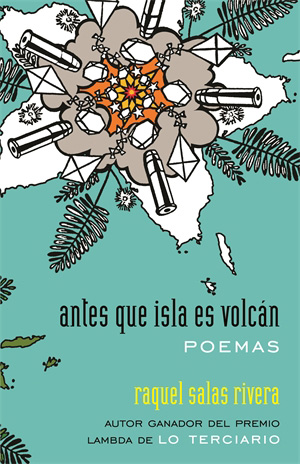
Gold Medal Winner of the Juan Felipe Herrera Award for Bilingual Poetry
From the National Book Award-nominated, Lambda Award-winning poet: a powerful, inventive
new collection that looks to the future of Puerto Rico with love, rage, beauty, and
hope
Roque Raquel Salas Rivera’s star has risen swiftly in the poetry world, and this,
his 6th book, promises to cement his status as one of the most important poets working
today. In sharp, crystalline verses, written in both Spanish and English versions,
antes que isla es volcán daringly imagines a decolonial Puerto Rico.
Salas Rivera unfurls series after series of poems that build in intensity: one that
casts Puerto Rico as the island of Caliban in Shakespeare’s The Tempest, another that imagines a multiverse of possibilities for Puerto Rico’s fate, a 3rd
in which the poet demands his right to a future and its immediate distribution. The
verses are rigorous and sophisticated, engaging with literary and political theory,
yet are also hard-hitting, charismatic, and quotable (“won’t you be sorry? / won’t
you wish you had a boss? / won’t you get restless / with all that freedom?”).
These poems tap unflinchingly into the explosive energy of the island, transforming
it into protest, into spirit, into art.
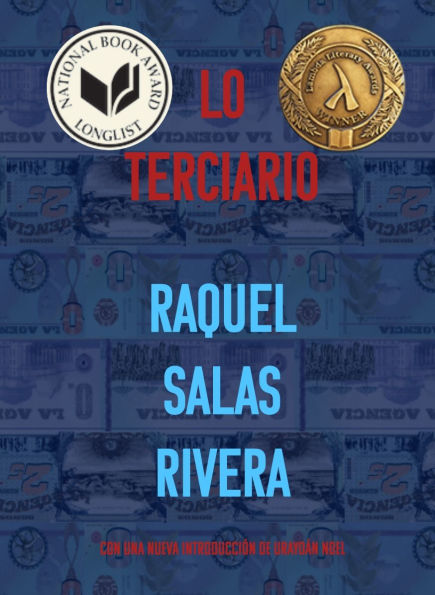
Akrilica, a co-publishing venture between Noemi Press and Letras Latinas — the literary initiative at the Institute for Latino Studies at the University of Notre Dame — showcases innovative Latino writing. The series name recalls the groundbreaking, bilingual book from the eighties by distinguished Chicano writer, and United States Poet Laureate Emeritus, Juan Felipe Herrera.
Written in response to the PROMESA bill (Puerto Rico Oversight, Management, and Economic Stability Act) Bill, lo terciario / the tertiary ofers a decolonial queer critique and reconsideration of Marx. The book's title comes from Pedro Scaron's, El Capital, the 1976 translation of Karl Marx's classic. Published by Siglo Veintiuno Editores, this translation was commonly used by the Puerto Rican left as part of political formation programs. lo terciario / the tertiary places this text in relation to the Puerto Rican debt crisis, forcing readers to reconsider old questions when facing colonialism's newest horrors.
Books by Amber Sparks
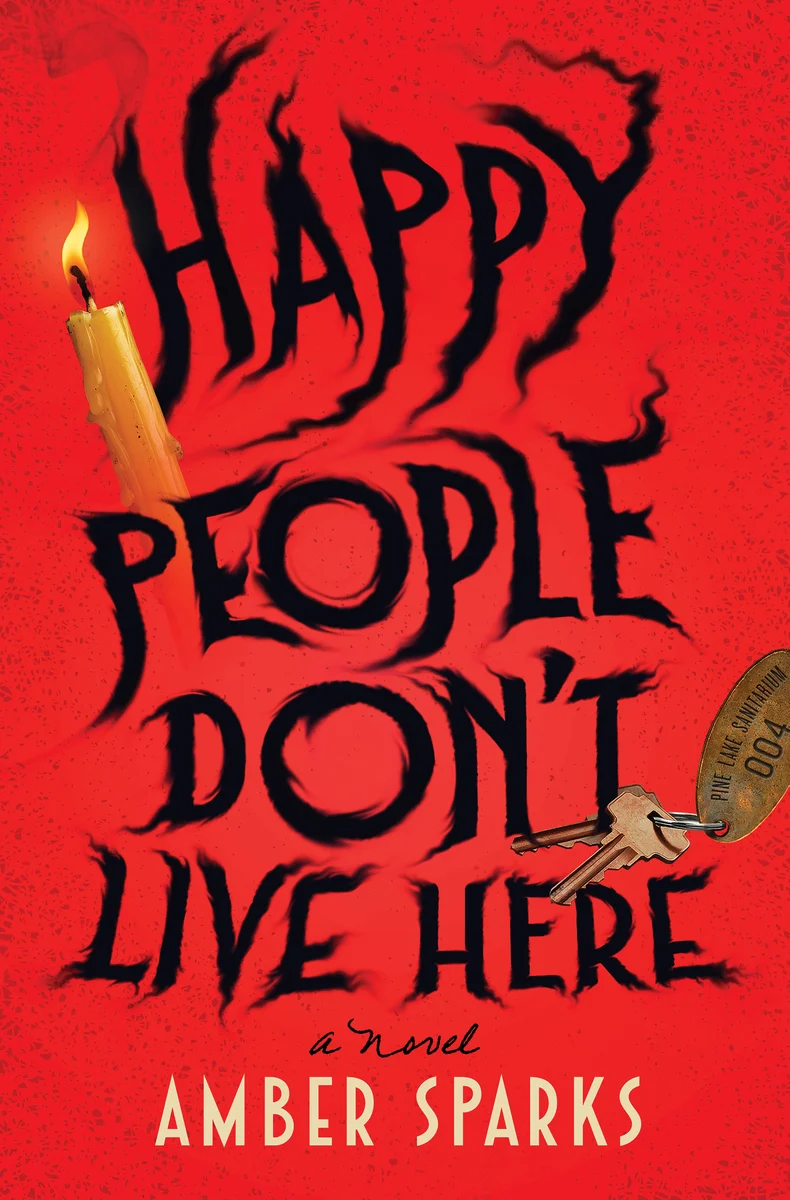
In this darkly funny gothic tale, a reclusive mother and her saturnine daughter move into a haunted building brimming with eccentrics—and secrets.
Just past the edge of summer, Alice and her daughter, Fern, arrive at the Pine Lake Apartments—a former sanatorium occupied by an ensemble of peculiar neighbors and a smattering of ghosts. Among the living: the Mermaid Lady, who performs in a nightclub fish tank; the building’s handyperson, moonlighting as a medium; and an awkwardly charming professor of medieval studies. Fern alone is acquainted with the undead, who pass like troubled clouds through the apartments, humanity mostly lost ages ago. For the determinedly private Alice, Pine Lake seems the perfect place at the edge of the world to hide herself and her daughter—until the day Fern finds a dead body in the dumpster.
Intent on solving the mystery of this discarded corpse, Fern eagerly puts her encyclopedic knowledge of detective novels to good use while dodging warnings from her increasingly paranoid mother. She soon comes to realize that within the strange tapestry of Pine Lake residents, nothing is ever quite as it seems. Her investigation digs up long-buried secrets, including her mother’s, that implicate each of her neighbors . . . and conjures a new one from beyond the grave.
The hotly anticipated debut novel from “master of the fantastic” (Roxane Gay) Amber Sparks, Happy People Don’t Live Here is an unforgettable portrait of family—whether by birth or by chance or by choice—and the sometimes dangerous myths we make to keep ours together.
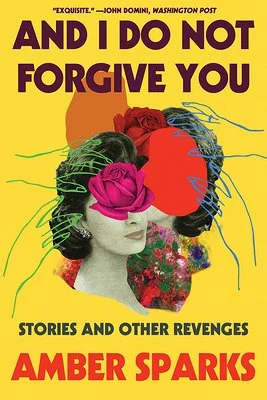
Amber Sparks holds her crown in the canon of the weird with this fantastical collection of “eye-popping range” (John Domini, Washington Post).
Boldly blending fables and myths with apocalyptic technologies, Amber Sparks has built a cultlike following with And I Do Not Forgive You. Fueled by feminism in all its colors, her surreal worlds—like Kelly Link’s and Karen Russell’s—are all-too-real. In “Mildly Happy, With Moments of Joy,” a friend is ghosted by a text message; in “Everyone’s a Winner at Meadow Park,” a teen coming-of-age in a trailer park befriends an actual ghost. Rife with “sharp wit, and an abiding tenderness” (Ilana Masad, NPR), these stories shine an interrogating light on the adage that “history likes to lie about women,” as the subjects of “You Won’t Believe What Really Happened to the Sabine Women” will attest. Written in prose that both shimmers and stings, the result is “nothing short of a raging success, a volume that points to a potentially incandescent literary future” (Kurt Baumeister, The Brooklyn Rail).
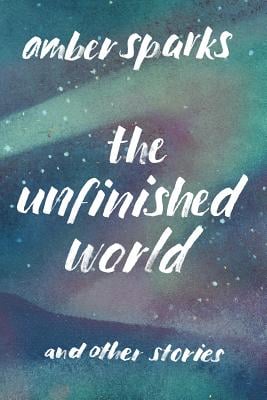
A Washington Post Best Science Fiction & Fantasy of the Year Selection
One of Electric Literature’s Best Short Story Collections of the Year
A highly anticipated collection of wildly imaginative short stories from “one of contemporary fiction’s true mad scientists” (Necessary Fiction).
In the weird and wonderful tradition of Kelly Link and Karen Russell, Amber Sparks’s dazzling new collection bursts forth with stories that render the apocalyptic and otherworldly hauntingly familiar. In “The Cemetery for Lost Faces,” two orphans translate their grief into taxidermy, artfully arresting the passage of time. The anchoring novella, “The Unfinished World,” unfurls a surprising love story between a free and adventurous young woman and a dashing filmmaker burdened by a mysterious family. Sparks’s stories—populated with sculptors, librarians, astronauts, and warriors—form a veritable cabinet of curiosities. Mythical, bizarre, and deeply moving, The Unfinished World and Other Stories heralds the arrival of a major writer and illuminates the search for a brief encounter with the extraordinary.