University of North Dakota
    • Admitted Students
    • Current Students
    • Families of Current Students
    • Faculty & Staff
    • Alumni
    • Email
    • Blackboard
    • Campus Connection
    • Employee Self-Service
    • Hawk Central
    • Degree Map
    • Zoom
  • Directory
  • Academics
  • Admissions
  • Student Life
  • Research
  • Athletics
  • Majors & Programs
  • About
University of North Dakota
  • Academics
  • Admissions
  • Student Life
  • Research
  • Athletics
  • Majors & Programs
  • About
  • Request Info
  • Visit
  • Apply
  • Request Info
  • Visit
  • Apply
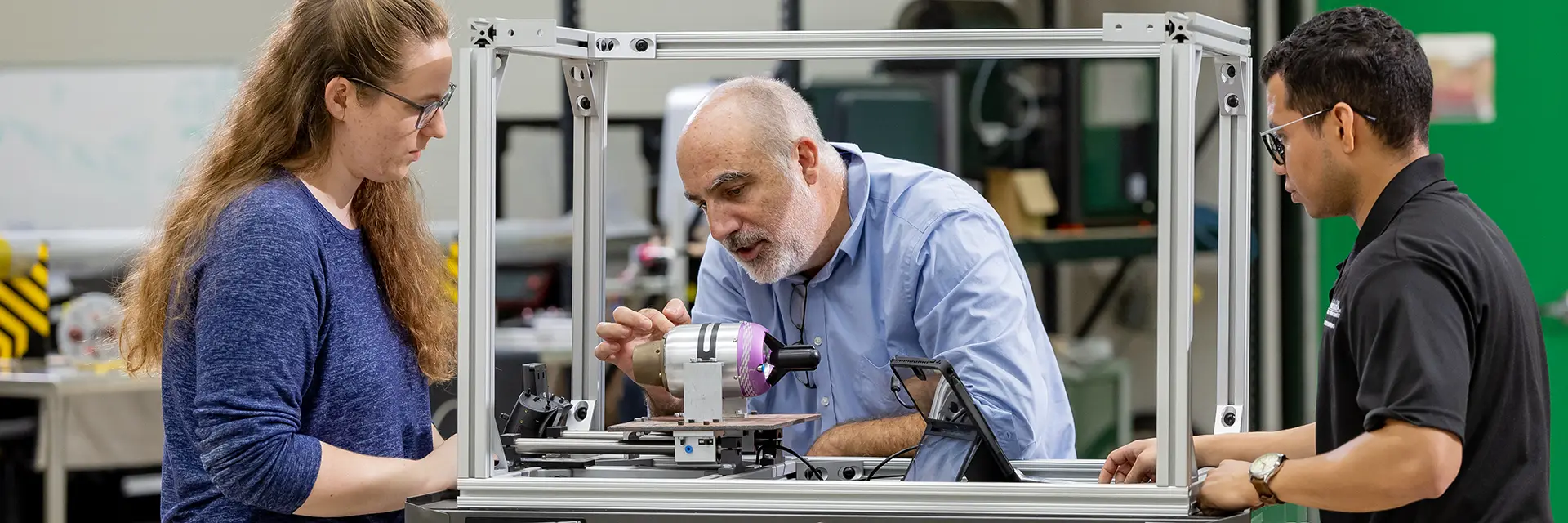
aerospace engineering masters students in lab
  • Home
  • Program Finder
  • Aerospace Engineering (M.S. or M.Eng.)

Master's in Aerospace Engineering

M.S. or M.Eng.

Design the systems behind next-generation aircraft, spacecraft and autonomous technologies.

UND's Aerospace Engineering master's is a rare integration of engineering and aerospace expertise, providing a highly customizable, research-driven graduate experience built around the future of aerospace innovation.

Program type:
Master's Degree
Format:
On Campus
Est. time to complete:
2 years
Credit hours:
30
  • Requirements
  • Tuition & Aid
  • How to Apply

Request Information

Why earn a master's in Aerospace Engineering at UND?

Graduate Application Deadlines
Fall:
Aug. 1
Spring:
Dec. 1
Summer:
May 1

If you're an international student, refer to the international application process for deadlines.


In this master’s program, you’ll study advanced aerospace engineering through a unique partnership between the College of Engineering & Mines and the John D. Odegard School of Aerospace Sciences.

This interdisciplinary approach lets you explore engineering fundamentals, emerging technologies, and applied research while tailoring your coursework to your technical interests and long-term career goals.

You’ll dive into advanced aerospace topics, including:

  • Flight dynamics and control
  • Propulsion systems
  • Computational fluid dynamics
  • Autonomous and unmanned systems
  • Aerospace structures
  • Space systems engineering

Through completion of this master's program, you will:

  • Collaborate on applied research and industry-aligned projects, gaining hands-on experience through faculty-led initiatives, research centers and partnerships with aerospace, defense and government organizations.
  • Build professional connections with faculty, peers, and industry partners that can lead to internships, collaborative projects and long-term career opportunities.
  • Customize your plan of study to align with your career objectives, with specialized coursework and project or thesis options in high-impact aerospace fields such as UAV/UAS technologies, hypersonics, propulsion and space systems.
  • Develop advanced technical, analytical and problem-solving skills needed for complex engineering roles in aerospace research, systems engineering, testing and technology development.
  • Stay competitive in a rapidly evolving industry with a flexible graduate program offered both on campus and online, designed to reflect current aerospace technologies and workforce needs.

Aerospace Engineering Master's Program

  • Gain advanced aerospace engineering expertise through a rare integration of engineering fundamentals and applied aviation sciences, preparing you to solve complex challenges across air, space and autonomous systems.

  • Access unmatched hands-on learning through live UAS flight testing and autonomous systems research at one of only seven FAA-designated UAS test sites in the nation.

  • Engage with industry- and government-aligned projects supported by long-standing partnerships with NASA, the Department of Defense, the FAA and leading aerospace contractors.

  • Participate in high-impact, faculty-led research through UND’s major research centers. Without the barriers of a Ph.D.-only research model, you’ll gain hands-on experience that directly translates to industry careers.

  • Customize your graduate experience with flexible on-campus and online options and an individualized plan of study aligned with your technical interests and career goals.

  • Build strong professional connections through close collaboration with faculty, peers and industry partners, positioning you for internships, advanced engineering roles and long-term career growth in aerospace and defense.

What can I do with an Aerospace Engineering master's degree?

134k

Median annual wage for aerospace engineers

U.S. Bureau of Labor Statistics

6%

Percent that employment of aerospace engineers is projected to grow from 2024 to 2034

U.S. Bureau of Labor Statistics

UND's master’s degree in Aerospace Engineering prepares you for a wide range of advanced, high-impact careers across aerospace, defense, space systems and emerging autonomous technologies. As innovation accelerates in aviation, space exploration, unmanned systems and national defense, demand continues to grow for engineers with specialized graduate-level expertise. Potential career paths include:

  • Aerospace Engineer: Design, analyze and test aircraft, spacecraft, propulsion systems and aerospace components. Work on improving performance, efficiency, safety and sustainability across commercial, defense and spaceflight applications.
  • Systems Engineer: Lead the integration of complex aerospace systems by coordinating design, analysis, testing and verification across multiple engineering disciplines. Ensure system performance, reliability and mission success from concept through deployment.
  • Flight Test Engineer: Plan and execute flight test for manned and unmanned aircraft. Analyze performance data, evaluate flight characteristics and support certification and validation efforts for new aerospace technologies and platforms.
  • Propulsion or Structures Engineer: Focus on advanced propulsion systems, materials and structural design. Analyze loads, thermal effects, fatigue and performance to support the development of aircraft, spacecraft and hypersonic vehicles.
  • UAV/UAS Engineer: Develop and test unmanned and autonomous systems, working on flight dynamics, autonomy, sense integration, communications and regulatory applications within both civilian and defense sectors.
  • Research or Technology Development Engineer: Contribute to applied research and emerging technology development in areas such as hypersonics, computational fluid dynamics, materials, autonomy and aerospace systems modeling.

Companies Hiring Aerospace Engineers

Notable companies hiring graduates with a master's in Aerospace Engineering include:

  • Air National Guard
  • Airbus
  • Boeing
  • GE Aerospace
  • Honeywell
  • Lockheed Martin
  • NASA
  • Northrop Grumman
  • Rolls Royce
  • SpaceX
  • U.S. Air Force
  • U.S. Department of Defense

Master's in Aerospace Engineering Courses

ME 464. Computational Fluid Dynamics. 3 Credits.

Computational fluid dynamics (CFD) is an introductory course focused on the numerical solution of partial differential equations (PDEs) using finite difference and finite volume methods. The course topics include the governing equations in fluid dynamics, classification of PDEs, boundary and initial conditions of PDEs, numerical discretization methods, analysis of numerical methods, model equations for incompressible and compressible flows, numerical methods suitable for model equations, and numerical linear algebra. Advanced topics in grid generation and turbulence modeling, important to practical applications of CFD, will also be discussed. Prerequisite: ME 341 with a grade of C or better, ME 306, and MATH 266. On demand.

ME 476. Intermediate Fluid Mechanics. 3 Credits.

Differential forms of conservation of mass, energy, and momentum for viscous fluid flow. Boundary layer theory and its applications. Principles of one-dimensional compressible flow. Prerequisite: ME 341 with a grade of C or better, ME 306, and MATH 266. On demand.

ME 477. Compressible Fluid Flow. 3 Credits.

Introduction to the theory and application of one-dimensional compressible flow. Course topics include isentropic flow in converging and converging/diverging nozzles, normal shock waves, oblique shock waves, Prandtl-Meyer flow, flow with friction and heat addition. Prerequisite: ME 341 with a grade of C or better and ME 306. On demand.


Leaders in Engineering

Helping you fulfill your aspirations is our highest priority. We'll work with you to design a custom educational plan that meets your goals.

Request Information

Explore More Options

Check out the UND aerospace engineering faculty or discover other graduate programs.

  • Department of Mechanical Engineering - Aerospace
  • Graduate Engineering Programs
Department Contact
Clement Tang
Chair & Associate Professor
P 701.777.5370
clement.tang@UND.edu

We use cookies on this site to enhance your user experience.

By clicking any link on this page you are giving your consent for us to set cookies, Privacy Information.

Ready to Enroll?

  • Request Information
  • Schedule a Visit
  • Apply Now
  • UND.info@UND.edu
  • 701.777.3000
  • Instagram
  • Facebook
  • LinkedIn
  • YouTube
  • TikTok
  • Contact UND
  • Campus Map
  • Events Calendar
  • Community & Belonging
  • Explore Programs
  • Employment
  • Make a Gift
  • Campus Safety (SafeUND)
University of North Dakota

© 2026 University of North Dakota - Grand Forks, ND - Member of ND University System

  • Accessibility & Website Feedback
  • Terms of Use & Privacy
  • Notice of Nondiscrimination
  • Student Disclosure Information
  • Title IX
©
UND.info@UND.edu
701.777.3000 | 1.800.CALL.UND
UND.edu/programs