University of North Dakota
    • Admitted Students
    • Current Students
    • Families of Current Students
    • Faculty & Staff
    • Alumni
    • Email
    • Blackboard
    • Campus Connection
    • Employee Self-Service
    • Hawk Central
    • Degree Map
    • Zoom
  • Directory
  • Academics
  • Admissions
  • Student Life
  • Research
  • Athletics
  • Majors & Programs
  • About
University of North Dakota
  • Academics
  • Admissions
  • Student Life
  • Research
  • Athletics
  • Majors & Programs
  • About
  • Request Info
  • Visit
  • Apply
  • Request Info
  • Visit
  • Apply
UND Biology Student Working with Plants on UND Campus
  • Home
  • Program Finder
  • Biology (B.S.)

Biology Degree

Bachelor of Science (B.S.)

Explore the science of living things through well-rounded coursework and hands-on research.

A degree in Biology from UND gives you the foundational knowledge and skills to thrive in any career. Our flexible options allow you to customize your major in anything from wildlife to pre-health.

Program type:
Major
Format:
On Campus
Est. time to complete:
4 years
Credit hours:
120
  • Requirements
  • Tuition & Aid
  • How to Apply

Request Information

Why choose UND's bachelor of science in Biology?

Application Deadlines
Fall:
Aug. 15
Spring:
Dec. 15
Summer:
May 1


If you're an international student, refer to the international application process for deadlines.


Biology is playing an increasingly important role, as society grapples with global issues such as overpopulation and climate change. With a biology major from UND, you'll gain:

  • An understanding of modern research techniques
  • Critical-thinking skills
  • A strong understanding of essential biological concepts
  • Quantitative reasoning ability
  • Broad exposure to all levels of biological organization, from molecules to ecosystems

You'll learn in state-of-the-art facilities, including:

  • Animal rooms for terrestrial and aquatic organisms
  • Tissue culture facilities
  • A biology core molecular facility
  • Four field stations
  • Two greenhouses

Customize Your Biology Major

UND's flexible biology program allows you to customize your major.

Fisheries and Wildlife Biology 

The B.S. with Major in Fisheries and Wildlife Biology prepares you for careers in state, private and federal fisheries and wildlife or conservation organizations.

General Biology 

The B.S. with Major in Biology allows you to customize the program of study to meet your needs. It allows for semesters with internships or study abroad.

Molecular and Integrative Biology 

The B.S. with Major in Molecular and Integrative Biology provides a strong foundation to you to continue your studies in medical science, graduate or professional programs.

Pre-Health

Pursue the B.S. with Major in Biology (Professional Health Sciences Emphasis, Pre-Health) if you are interested in medicine or allied medical fields.

Why UND for your Biology degree?

  • Build strong research and communication skills by participating in interactive classes and research projects.

  • Engage in independent studies under direct faculty supervision.

  • Let our team of academic advisors help you plan your major. You'll also have access to personalized software to keep you on track to graduate in four years.

  • Participate in internships or experiential learning supported by local and national programs. Students have interned at the National Science Foundation Research Experience for Undergraduates (NSF-REU) and the National Institutes of Health Summer Undergraduate Biomedical Research Experience (SUBRE).

  • You'll have the opportunity to tailor your coursework to your primary areas of research. Many students study conservation biology, grassland ecology, or animals and their parasites.

  • Join organizations such a the Wildlife Society and North American Vascular Biology Association (NAVBO).

Career Opportunities with a Biology Degree

87k

Median annual salary for biological scientists, 2024

U.S. Bureau of Labor Statistics

5%

Projected job growth for biological scientists through 2032

U.S. Bureau of Labor Statistics

Why Biology is a Future-Proof Choice

With your bachelor's degree in biology, you'll be prepared for diverse career paths and high-demand positions, such as: 

  • Career Versatility: A biology degree is one of the most versatile undergraduate degrees you can earn. Whether you're interested in healthcare, research, education, environmental conservation, or biotechnology, a B.S. in Biology provides the foundation you need.
  • Job Security: The demand for skilled biologists continues to grow as society faces challenges like climate change, emerging diseases, and the need for sustainable food production. Your expertise will be indispensable.
  • Graduate School Preparation: Our program is designed to prepare you for advanced degrees in medicine, dentistry, veterinary science, or graduate-level research programs.

Top Career Paths for Biology Graduates

UND Biology graduates have built rewarding careers in a wide range of industries, including:

  • Biotechnology
  • Conservation biology/ecology
  • Education (secondary and higher education)
  • Health sciences
  • Medical laboratory research
  • Medicine
  • Natural resource management
  • Scientific research
  • Secondary school teaching
  • Veterinary medicine

Jobs with a Major in Biology

UND biology majors have gone on to a variety of successful careers with:

  • Abbott Laboratories
  • Altru Health System
  • Parexel
  • Sanford Health
  • University of Minnesota

What skills will you develop?

Gain hands-on expertise in essential biological concepts and laboratory techniques:

  • Scientific Research and Methodology: Design and conduct experiments, collect and analyze data, and draw evidence-based conclusions.
  • Laboratory Skills: Master techniques such as DNA extraction and analysis, cell culturing, microscopy, and molecular biology procedures.
  • Critical Thinking and Problem Solving: Analyze complex biological systems and develop innovative solutions to real-world challenges.
  • Quantitative Analysis: Apply mathematical and statistical methods to interpret biological data.
  • Scientific Communication: Effectively communicate complex scientific information through written reports, oral presentations, and visual displays.
  • Understand the relationships between organisms and their environments, from individual interactions to ecosystem dynamics.

Courses You'll Take

BIOL 315. Genetics. 3 Credits.

An introduction to genetics, with emphasis on classical genetic analysis and the biochemistry of gene transmission, expression and regulation. Prerequisite: BIOL 150, BIOL 150L, BIOL 151, and BIOL 151L or an equivalent approved by the department. F.

BIOL 439. Conservation Biology. 3 Credits.

A course that integrates information from the disciplines of ecology, genetics, biogeography, economics, environmental policy, and ethics towards understanding how to maintain and restore biological diversity. F, odd years.

BIOL 364. Parasitology. 2 Credits.

Classification, structure, functions, and life-cycles of parasites having importance to human, wildlife and veterinary health. Prerequisite: BIOL 150, BIOL 150L, BIOL 151, and BIOL 151L. F, odd years.

BIOL 410. Molecular Biology Techniques. 4 Credits.

Applications of DNA and RNA analysis and recombinant DNA technologies, emphasizing practical experience in the laboratory. This class will meet twice a week for 50 minutes in the classroom, and students will be expected to work approximately 4-6 hours a week in the lab during open lab times. Counts as an upper-division laboratory course. Prerequisite: BIOL 315 is recommended. S.

BIOL 332. General Ecology. 3 Credits.

An introduction to ecology. Covers the relationship of individuals, populations, communities and ecosystems to their biotic and abiotic environments. Prerequisite: BIOL 150, BIOL 150L, BIOL 151, and BIOL 151L or an equivalent approved by the department. F.

BIOL 336. Systematic Botany. 4 Credits.

Morphology, evolution, and classification of vascular plants with emphasis on the flora of the Great Plains. Counts as an upper-division laboratory course. Prerequisite: BIOL 150, BIOL 150L, BIOL 151, and BIOL 151L or permission of instructor. F, even years.

Alumni Spotlights

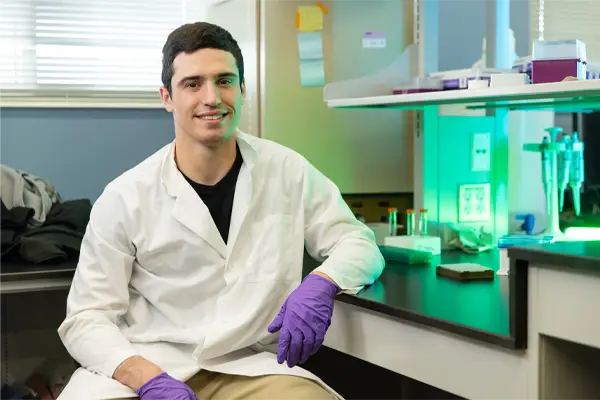
merrick mcmahon working in lab


Merrick McMahon

"UND made it easy to network with people. I met several mentors who helped me gain that confidence. They were there to guide me. They helped me believe in myself and showed me I shouldn't be afraid to pursue those leadership roles."

- Merrick McMahon, Biology and Pre-Dentistry Graduate


Mason Curtis

"The professors here genuinely care. My research mentor, Dr. Keith Henry, has been instrumental in teaching me lab skills and critical thinking."

"No matter where you come from, you can achieve anything. UND gave me the support to turn my goals into reality."

- Mason Curtis, Biology Graduate (B.S./M.S.)
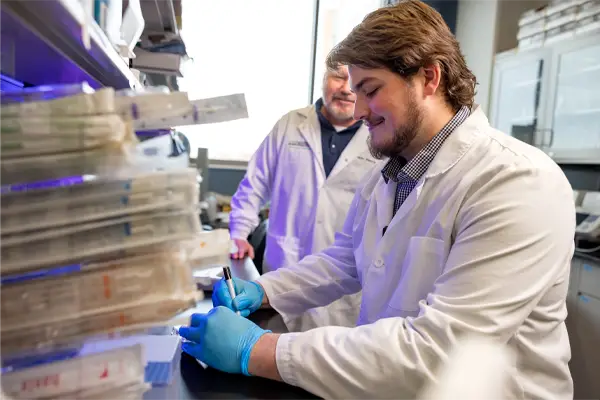
mason curtis working in lab

Leader in Action

Biology student, Merrick McMahon, aims to improve health care in tribal communities.

Read Merrick's Story

Frequently Asked Questions

A B.S. in Biology opens doors to numerous career paths. Graduates can pursue advanced degrees in medicine, dentistry, veterinary science, or graduate research programs. Others enter careers in biotechnology, pharmaceuticals, environmental consulting, wildlife management, education, or government research labs.

Absolutely. Our B.S. in Biology with a Pre-Health emphasis is specifically designed to meet the requirements for medical school, dental school, and other health professional programs. It provides a strong foundation in the biological and chemical sciences, along with research and clinical opportunities that strengthen your application.

UND emphasizes hands-on learning. Biology majors can participate in faculty-led research projects, engage in independent studies, or apply for competitive summer research programs like the National Science Foundation's Research Experience for Undergraduates (NSF-REU) or the National Institutes of Health's Summer Undergraduate Biomedical Research Experience (SUBRE). Our modern labs and field stations provide excellent environments for discovery.

Yes. Our flexible curriculum allows you to specialize in areas that align with your career goals. Popular specializations include:

  • Fisheries and Wildlife Biology (for students interested in conservation and ecosystem management).
  • Molecular and Integrative Biology (for those aiming for graduate school or careers in biotech).
  • Pre-Health track (for students planning to attend medical, dental, or veterinary school). 

You can also customize a general biology track with internships or study abroad experiences.

UND's Biology program stands out for its combination of dedicated faculty mentorship, extensive hands-on research opportunities for undergraduates, and state-of-the-art facilities. We are large enough to offer diverse opportunities but small enough to provide a personalized and supportive learning environment. Plus, our location in North Dakota provides unique access to diverse ecosystems for field research.

Our rigorous curriculum, research opportunities, and faculty mentorship are designed to prepare you for the next step in your education. Many of our students go on to top graduate programs and professional schools. We also provide advising specifically for students applying to medical, dental, and veterinary schools, including help with applications, personal statements, and interview preparation.

Yes. We encourage students to gain real-world experience through internships with local and national organizations. Many biology students also participate in study abroad programs, which can be integrated into your degree plan. 


Request Information

Explore More Options

Looking to connect with the college or find a similar degree?

  • College of Arts & Sciences
  • Find Similar Degrees

We use cookies on this site to enhance your user experience.

By clicking any link on this page you are giving your consent for us to set cookies, Privacy Information.

Ready to Enroll?

  • Request Information
  • Schedule a Visit
  • Apply Now
  • UND.info@UND.edu
  • 701.777.3000
  • Instagram
  • Facebook
  • LinkedIn
  • YouTube
  • TikTok
  • Contact UND
  • Campus Map
  • Events Calendar
  • Community & Belonging
  • Explore Programs
  • Employment
  • Make a Gift
  • Campus Safety (SafeUND)
University of North Dakota

© 2026 University of North Dakota - Grand Forks, ND - Member of ND University System

  • Accessibility & Website Feedback
  • Terms of Use & Privacy
  • Notice of Nondiscrimination
  • Student Disclosure Information
  • Title IX
©
UND.info@UND.edu
701.777.3000 | 1.800.CALL.UND
UND.edu/programs