Economic Impact Analysis
Current impact, emerging trends and future legacy.
This summary report examines the economic impact of the University of North Dakota (UND), estimating and detailing the university's impact on both the state and regional economies, including impacts related to employment, labor, industry and taxes. The report highlights UND’s extensive contributions to North Dakota’s economy and its role in fostering growth, resilience, and innovation across the region and beyond.
Introduction
UND, located in Grand Forks, ND, is the oldest and largest university in North Dakota. To promote access to diverse professional opportunities, enhance earning potential and strengthen social mobility, UND offers over 400 programs, from certificates to doctoral programs in 15 disciplines.
Each year, UND graduates nearly 3,000 well- prepared individuals who make significant contributions to the workforce regionally, statewide and beyond. However, UND’s impact extends far beyond the exceptional education that it provides. The spending by UND, its students and its visitors generates a ripple effect that enhances the economy of North Dakota and the Grand Forks region. This impact fosters employment, boosts labor income, stimulates industry activity and contributes to tax revenue, solidifying UND’s role as a cornerstone of economic and social vitality.
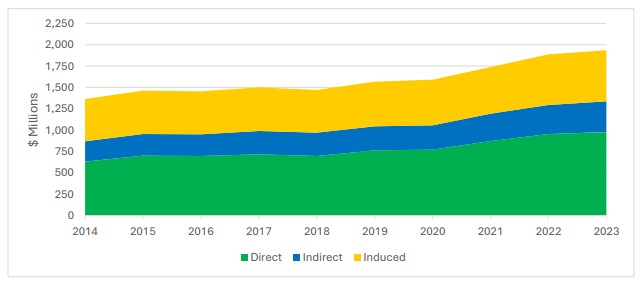
As noted in Figure 1 below, the economic impacts of UND on the ND economy have been large, diverse, and increasing over the past decade, peaking in the 2022-23 academic year, where UND contributed $1.93 billion in industry activity, supported 16,984 jobs, generated $1.13 billion in labor income, and delivered $284.89 million in total tax revenue at the state level. To the Grand Fork regional economy, UND sustained 17,404 jobs and contributed $1.87 billion in industry activity and $1.14 billion in labor income, underscoring its role as a key economic driver.
Research and Development (R&D) are central to UND’s mission, with expenditures reaching $136.34 million in 2023. These initiatives advance innovation, diversify the economy, and strengthen workforce skills in areas such as energy, health sciences, and aerospace. UND’s commitment to excellence in education and research ensures long-term benefits for students, faculty, staff and the broader community, generated $3.83 in economic returns for every dollar invested.
Figure 1: Total Impacts of UND on ND, 2014-23
A Decanal Review of Expenditures (2014-2023)
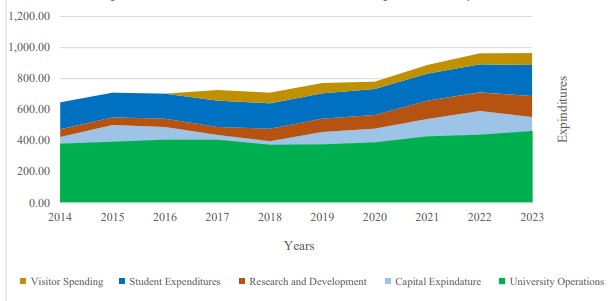
The financial trajectory of higher education institutions, particularly public universities, serves as a crucial indicator of their economic footprint and broader impact on regional development. This analysis examines the expenditures of UND from 2014 to 2023, highlighting trends across key functional categories: University Operations, Capital Expenditure, Research and Development, Student Expenditures, and Visitor Spending. Using a decade’s worth of financial data, this analysis draws insights into UND’s institutional priorities, its role in the economy, and potential policy implications for future investments.
Figure 2: Trends in Annual UND-Related Expenditures
By area: 2014-23
Note: Data derived from IPEDs.
UND’s expenditures and spending by students and visitors over the period demonstrate significant fluctuations across functional categories, with notable increases in several key areas. In 2023, the total expenditure reached $964.37 million, representing one of the highest points in the decade. This total marks a substantial increase from the 2014 figure of $646.53 million. The ten-year average, calculated at $786.19 million, indicates an upward trend, albeit with intermittent variability that may be attributable to external economic factors and strategic institutional decisions.
UND's State Level Impact, 2023
UND plays a pivotal role in shaping the economic landscape of the state and region. Through its diverse expenditures across operating, capital, research and development (R&D), student spending, and visitor spending, UND significantly influences employment, labor income, industry activity, and tax revenues within the state. With an industry activity multiplier of 1.9, each dollar spent directly by UND generates an additional dollar in regional economic output, illustrating the interconnectedness of the university’s operations with the state’s economy.
The employment multiplier of 1.4 indicates that each direct job at UND supports an additional 0.4 jobs elsewhere in the economy, underscoring the ripple effects of university employment on job creation. Table 1 breaks UND’s impact on the state economy down by categories and shows direct, indirect, induced and total impacts, as well as how these impacts are distributed throughout the state’s economy. Table 2 shows how these impacts are distributed across functional expenditure categories.
Table 1: Summary Impacts of UND on North Dakota Economy
All Categories (2023)
| Input | Employment | Labor Income | Industry Activity | Tax Impact |
|---|---|---|---|---|
| Direct | 11906 | 851.39 | 975.87 | 196.75 |
| Indirect | 1601 | 92.32 | 960.43 | 28.37 |
| Induced | 3476 | 192.74 | 598.40 | 59.76 |
| Total | 16984 | 1,136.46 | 1,934.70 | 284.89 |
Source: UND IPBA’s IMPLAN Analysis. The Employment Column reflects the number of jobs. Other columns reflect 2023 USD (in millions), adjusted to 2025 USD.
- Direct Employment: The 11,906 direct jobs at UND encompass various positions, including faculty and administrative staff. These roles not only provide stable employment but also attract talent to the state, enhancing the state labor market.
- Indirect Employment: The 1,601 indirect jobs generated through the university’s supply chain emphasize the economic interdependencies within the region. As businesses expand to meet UND’s demands, they create additional job opportunities that strengthen state level employment prospects.
- Induced Employment: The 3,476 induced jobs resulting from increased local spending by UND employees highlight the broader employment effects of the university, contributing to a diversified job market and supporting vital sectors such as retail and services.
The total labor income associated with UND’s operations amounts to $1.13 billion. This figure is composed of several key components:
- Direct Labor Income: The $851.39 million in direct labor income reflects the salaries and wages paid to UND employees, significantly contributing to household incomes. This income is essential for the financial stability of families in the region, enhancing their purchasing power and overall quality of life.
- Indirect Labor Income: An additional $92.32 million is generated through indirect labor income from businesses that supply goods and services to UND. This highlights the interconnectedness of the university with suppliers and the symbiotic relationship that fosters economic growth.
- Induced Labor Income: The $192.74 million in induced labor income arises from spending by university employees in the economy. As employees utilize their earnings on various goods and services, they stimulate further economic activity, highlighting the broader impact of UND’s operations.
The total industry activity linked to UND is $1.93 billion, consisting of:
- Direct Industry Activity: The $975.87 million in direct industry activity represents the core operations of the university, including expenditures on facilities, educational programs, and operational costs. This direct spending serves as a critical stimulus for businesses.
- Indirect Industry Activity: An estimated $360.43 million results from indirect industry activities, representing
the economic impact of businesses that provide goods and
services to the university. This figure underscores the university’s role in supporting a network of suppliers. - Induced Industry Activity: The $598.40 million in induced activity reflects the economic contributions from increased spending in the community, further emphasizing the importance of UND in generating economic growth across multiple sectors.
The total tax revenue generated from UND’s operations is $284.89 million, which plays a crucial role in supporting state government services. This total includes:
- Direct Tax Revenues: The $196.75 million in direct tax revenues is attributable to the university’s operational activities, including property taxes and payroll taxes. These revenues are essential for funding public services such as education, healthcare, and infrastructure maintenance.
- Indirect Taxes: The $28.37 million in indirect taxes arises from business transactions related to UND, including sales taxes generated by suppliers. This revenue reinforces the university’s role in contributing to public financing and community development.
- Induced Taxes: The $59.76 million in induced taxes is generated by consumer spending facilitated by labor income, demonstrating the cascading effects of UND’s economic activities. This revenue is crucial for local and state budgets, supporting essential community services.
Table 2: Summary Impacts of UND on North Dakota Economy
By category (2023)
| Input | Employment | Labor Income | Industry Activity | Tax Impact |
|---|---|---|---|---|
| Operational Expenditures | 5,477 | 424.81 | 856.72 | 110.11 |
| Capital Expenditures | 5,415 | 452.25 | 376.71 | 108.78 |
| R&D Expenditures | 1,117 | 90.92 | 233.10 | 23.53 |
| Student Spending | 3,895 | 132.94 | 341.59 | 30.35 |
| Visitor Spending | 1,080 | 35.54 | 126.57 | 12.12 |
| Total | 16,984 | 1,136.46 | 1,934.70 | 284.89 |
UND's Impact on Grand Forks Regional Economy
UND serves as an important driver of economic prosperity and community engagement in the region. It plays a pivotal role in shaping the region’s economy, social landscape, innovation ecosystem, and policy frameworks. The university’s research initiatives drive innovation and help diversify the local economy, ensuring long-term resilience. UND’s will continue to propel the region forward, solidifying its role as a leader in shaping the economic future of the region.
UND’s economic impact is underpinned by employment, labor income, industry activity, and tax revenue generation (see Table 3), supporting 17,404 jobs across various sectors and generating over $1.8 billion in business activity, while contributing significantly to local tax revenues. Table 3 breaks UND’s impact on the regional economy down by categories and shows direct, indirect, induced and total impacts, as well as how these impacts are distributed throughout the state’s economy. Table 4 shows how these regional impacts are distributed across functional expenditure categories.
Table 3: Summary Impact of UND on Regional Economy
All categories (2023)
| Input | Employment | Labor Income | Industry Activity | Tax Impact |
|---|---|---|---|---|
| Direct | 12,104 | 848.75 | 961.61 | 195.60 |
| Indirect | 1,837 | 101.50 | 357.03 | 15.57 |
| Induced | 3,463 | 192.61 | 552.55 | 29.15 |
| Total | 17,404 | 1,142.85 | 1,871.19 | 240.31 |
Notes: UND IPBA’s IMPLAN Analysis. The Employment Column reflects numbers of jobs. Other columns reflect 2023 USD (in millions), adjusted to 2025 USD.
Table 4: Summary Impacts of UND on Regional Economy
By category (2023)
| Input | Employment | Labor Income | Industry Activity | Tax Impact |
|---|---|---|---|---|
| Operational Expenditures | 5,578 | 439.55 | 863.45 | 96.97 |
| Capital Expenditures | 5,323 | 440.03 | 326.07 | 92.87 |
| R&D Expenditures | 1136 | 93.32 | 232.37 | 20.30 |
| Student Spending | 4177 | 136.18 | 331.46 | 20.76 |
| Visitor Spending | 1190 | 33.79 | 117.84 | 9.42 |
| Total | 17,404 | 1,142.85 | 1,871.19 | 240.31 |
Notes: UND IPBA’s IMPLAN Analysis. The Employment Column reflects the number of jobs. Other columns reflect 2023 USD (in millions), adjusted to 2025 USD.
UND directly and indirectly supported 17,404 jobs across various sectors. The extent of these employment impacts underscores UND’s pivotal role as a leading employer and economic engine within the community, facilitating both direct job creation and secondary employment through supply chain dynamics and local household expenditure.
This impact can be categorized as follows: direct employment supports 12,104 jobs, indirect employment accounts for 1,837 jobs, and induced employment comprises 3,463 jobs. Research and Development (R&D) initiatives are a key pillar of UND’s mission and account for 1,136 jobs, further reinforcing the institution’s role in fostering high-skill, knowledge-intensive employment within the region.
UND significantly enhances the region’s economic health by generating over $1.13 billion in wages and salaries. Direct employment contributes $848.75 million, while indirect employment adds $101.50 million, and induced employment generates $192.61 million.
This income has broader implications, driving consumption and investment within the regional economy. The labor income generated by capital projects, R&D, and student and visitor spending further amplifies the university’s fiscal impact, promoting income stability and growth across the workforce.
In 2023, UND’s overall contribution to industry activity within the Grand Forks reached over $1.87 Billion. Of this, direct industry activity, primarily arising from the university's operational expenditures, amounts to $961.61 million. Indirect industry activity, which includes supply chain effects, contributes $357.03 million, while induced industry activity, driven by local expenditure from wages, adds $552.55 million. Additionally, capital expenditures industry impact accounted for $326.07 million, reflecting the university’s commitment to infrastructure and facility development. The economic activities linked to R&D generated $232.37 million, underscoring UND’s role in advancing regional innovation. Student and visitor spending further contribute to the local economy, generating a combined total of $449.30 million in industry activity, predominantly within retail, hospitality, and service sectors.
Conclusion
The economic contributions of UND underscore the institution’s critical role in the North Dakota and Grand Forks regional economies and highlight several important business and policy considerations:
- Investment in Education and Workforce Development: The substantial employment and labor income generated by UND’s operations illustrate the university’s role as a key contributor to workforce development in North Dakota. UND supports education and skill development, essential for advancing the state’s economic diversification strategy.
- Support for Businesses: The indirect effects of UND’s expenditures, particularly in terms of industry activity, provide a robust opportunity for businesses, particularly regional, to engage with the university. UND’s spending fosters partnerships with industry, driving innovation and being economically resilient.
- Infrastructure: Capital expenditures not only create jobs but also improve community infrastructure. UND’s collaboration with city planners to align university expansion with local development plans further maximize economic benefits.
- Sustainability: As economic conditions fluctuate, the reliance on diverse funding sources for operations, capital, and research will be critical. UND’s decade expenditure trend reveals that the university has given revenue diversification attention and the current pattern promotes sustainable practices that enhance long term economic resilience.
- Research Commercialization: Leveraging R&D expenditures can attract investments, foster innovation and create new business opportunities. The Institute of Policy and Business Analytics and other relevant offices at UND should continue to facilitate commercialization.
- Visitor Economy: UND events and activities contribute significantly to state tourism and state/local tax revenues.
Prepared by the Institute of Policy and Business Analytics. Spring 2025.